Actually, I am going to introduce the block across the street from my block because it explains my neighborhood better than I could…both physically, politically, and socially…locally and nationally.
My Photo of the Robert Mills unit across directly across Logan Street.
This Sanborn Fire Insurance map below shows what the block looked like before 1938. Note: Mazyck Street will be renamed Logan Street. The map is dated 1902. My block is to the right of Mazyck/Logan Street and runs from Beaufain Street to the little unnamed street coming in from the right we know as West Street. The across the street block is more than twice as big as my block and is uncut with a street all the way to Magazine Street. It is fairly dense with buildings.
Sanborn Fire Map “1902 Clip” Robert Mills Manor
In 1938, the block “would be razed to make space for the Whites only Robert Mills Manor housing complex.”
That quote and map are from a Public Housing report (undated) that looked in depth at the block and the reasons for tearing everything down. I will quote directly the parts that interest me about the neighborhood and will give a link to the whole report at the end:
ROBERT MILLS MANOR (PUBLIC HOUSING), 6 WILSON STREET Charleston, Charleston County, South Carolina…
HISTORIC AMERICAN BUILDINGS SURVEY ROBERT MILLS MANOR (Public Housing…The Robert Mills Manor remains as Charleston’s earliest and most intact example of a locally initiated public low-income housing project. During the 1930s, the federal government began subsidy programs for the development of low-income housing and for slum clearance. The City of Charleston quickly took advantage of these programs, developing several large low-income projects, the first of which was the Robert Mills Manor… the site is an example of excellent early twentieth century institutional architecture and planning…
PART I. PHYSICAL HISTORY AND SETTING OF THE ROBERT MlLLS MANOR…is a multi-family residential structure…a thirty-four-building low-income housing project. The project is located…within Harleston Village, a predominantly residential neighborhood of large and medium scale eighteenth, nineteenth, and early-twentieth century structures. The neighborhood is listed on the National Register of Historic Places as part of the Charleston Old and Historic District (listed 1970, extended 1978, and amended 1988) …
The Robert Mills Manor was constructed as a low-income housing project in two phases which were completed in 1939 and 1941, respectively…Demolition of existing structures on the site began immediately.…
PART II. HISTORICAL CONTEXT-PUBLIC HOUSING IN CHARLESTON The federal government began to involve itself in the issue of slums as early as the 1890s when it conducted a series of hearings on the subject. While the hearings produced no specific programs, they did result in increased public awareness of the nation’s housing problems…
A 1934 federal inventory of property in sixty-two cities conducted by the U.S. Department of Commerce indicated the need for an overall improvement in Charleston’s residential building stock: twenty-two percent of the city’s houses were considered in need of major repair, twenty-one percent were without running water, almost fifty percent were without indoor toilets, more than fifty percent were without a bath tub or shower, the city’s death rate was almost twice the national average, and the city’s infant mortality rate was more than fifty percent above the national average.
A similar study conducted by the Works Progress Administration, released in 1940, examined 18,477 dwelling units in 10,586 structures within the city. More than forty percent of the units were found to be substandard due to physical condition, defined as being in need of major repair or unfit for use, and/or overcrowding, defined as greater than one and one-half persons per room. Eighty-six percent of the structures had been built prior to 1919 and 1, 101 units were considered to be unfit for occupancy. Charleston mayor Burnet R. Maybank responded to the problems indicated in the 1934 federal study by initiating efforts to convince City Council of the need for slum clearance and providing adequate low-income housing. A Housing Commission was established in October 1933 and was charged with identifying areas of the city requiring attention…which did instigate the creation of the Housing Authority of the City of Charleston. (One of the first board members was the only woman: “Clelia P. McGowan, a widow.”)
From there on for several long paragraphs, it gets political. Commissions and studies and laws passed. After reading what the process was for getting Canterbury House built for low-income seniors, I developed a better understanding of the process…the sausage making…it can be bloody but necessary. I prefer to leave it mostly behind the scenes.
PART Ill. SPECIFIC HISTORY-ROBERT MILLS MANOR By the early twentieth century, the area that would become the Robert Mills Manor site consisted of a large assemblage of dilapidated late-19th and early- 20th century residences and tenements surrounding the county’s jail on the corner of Franklin and Magazine Streets. Conditions at the site had deteriorated to the point where contemporary accounts called it: “the worst disease breeding spot in the lower section of the city. Its existence was a constant police problem and fire hazard. Its crowded poorly lighted, evil smelling tenements depreciated the entire section of the city.”
In its 1937 report published in the City Year Book, the Housing Authority announced its intention to take full advantage of the Housing Act…and was granted one of the U.S. Housing Authority’s first awards for $900,000 to be used for the construction of the Robert Mills Manor, named in honor of the architect of the Marine Hospital, one of the notable buildings in the development area. (More later.)
City Directories for 1938 indicate that virtually all of the residents in the area were black….
City Directories for the period from 1939 to 1945 indicate a diverse mixture of tenants, including carpenters, seamstresses, drivers, waitresses, machinists, widows, etc. The Robert Mills Manor was originally constructed for white residents only. The slum clearance project that was carried out prior to its construction resulted in the displacement of some eighty black families…
A ca. 1946 newspaper article on public housing in the city indicated that “the need for low-cost housing is far greater among negroes than among white persons, that the proportion of applications is about nine to one.” Authority Executive Director Clement is quoted as saying: “Unfortunately, (and ironically cmf) negro family compositions do not meet with the authority’s requirements in many cases…Unlike most landlords, preference is given by the authority to families consisting of husband, wife and children. Broken families are placed on the deferred list. Many applications, particularly among negroes, for a grandmother and grandchildren, or a woman with several adopted children are received. Such applications are placed on a deferred list under existing regulations.” Occupancy of the project was restricted to white families until the early 1960s when the Housing Authority quietly integrated in compliance with the Civil Rights Act of 1964…
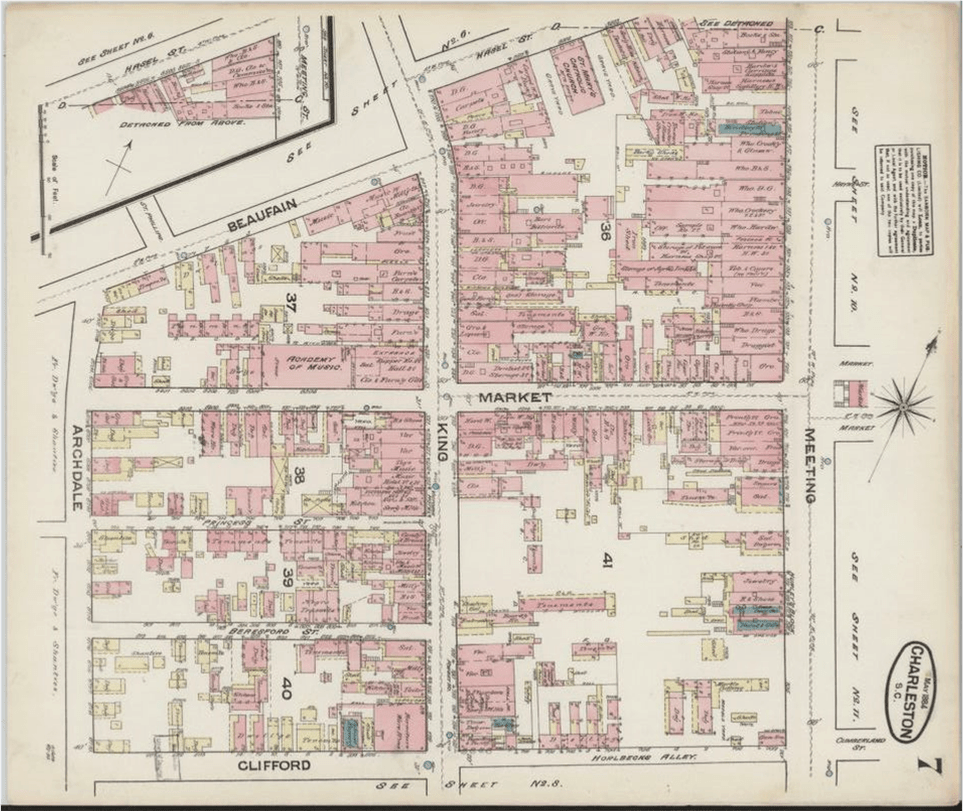
You may recall that in the Post and Courier article from 1953 (in an earlier post), Alderman Halsey said that a “negro tenement” had recently been torn down in my block, also, as part of the continuing effort at slum eradication when the city purchased the block for parking lots…and discovered a graveyard. An 1884 Sanborn Map I posted earlier (below) showed that Archdale Street was the very edge of the city then…there were houses on the east side of Archdale but the map ended at the street. The west side had only the words “Dwellings and Shanties.” (Handwriting on far left of map…can see the words if you enlarge map enough.)
Through the Robert Mills project, we can see the city struggle with cleaning itself up and rehabilitating its problem area…and while a lot of unhealthy and below any conceivable standard for housing buildings were “cleared” and new low-income housing built, it was in large part because the U.S. government subsidized it…all good…but it would take almost 30 years before Charleston allowed any of its displaced “negro” families to live it it…until the U.S. Congress passed the Civil Rights Act in 1965…and, also ironically, the Robert Mills Manor slowly or quickly reverted to an “all black tenement.”
From the building of Robert Mills Manor in ca 1940, it will be 30 years before that Canterbury House was built as the first low-income housing for seniors…and was not segregated from the start. (Robert Mills Manor was being built the year I was born, and I am now 83…and so are those buildings, though the yards are kept up well…some of the buildings have needed major work…as have I. (See the photo above.)


 Finding "My" Charleston...Digging down on the block I live on...to see what I can find.