Phase Two–1835-1848–The Church Under My Parking Lot…and Fire
Continuing with the Charleston SC 1873 News and Courier article of an interview and sermon by Rev. Dana from Third Presbyterian Church…under my parking lot…
“The half-century under review may be divided into four parts. The first of twelve and a half years; (the last post, Phase One) the second twelve and a half years, ending July 1848;
“He who addresses you today,” the pastor continued, “was called to the charge of this flock November 9th, 1835. (Almost two years after their first pastor Reverend McDowell left.) My connection with this church has occupied three-fourths of the half century under consideration…”
I’m going to stop Reverend Dana, again, right there and pursue my favorite research technique…place two seemingly unrelated subjects chronologically side by side to see what happens.
I did the same thing in the Phase One post where it revealed the Third Presbyterian Church, their first pastor, and the early abolition movement in (an uneasy) relationship. Now, googling 1830s Charleston to see what specifically might be going on in Phase Two, something also emerged. What Reverend Dana walked into when he “was called to charge of this flock” and what the block and the neighborhood and the city were going through in those years is told in one word…Fire.
A Decade of fire
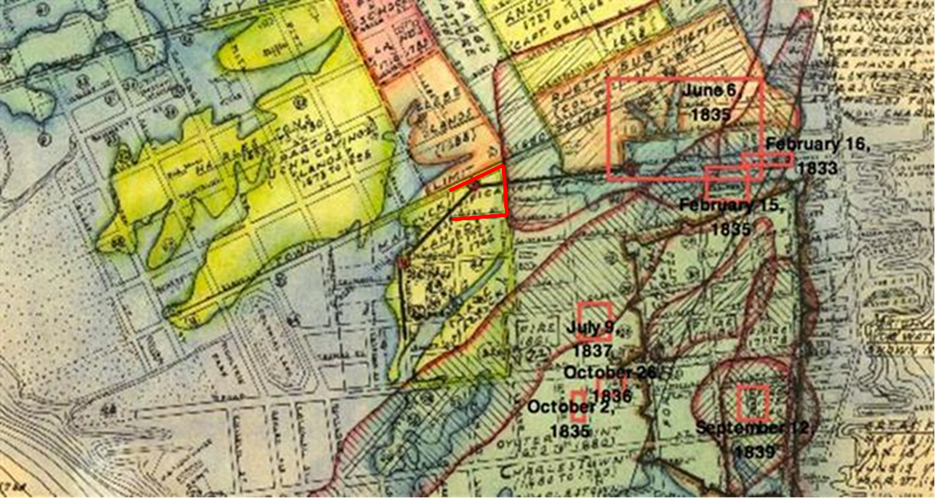
Local historians call the 1830s the Decade of Fire on the old town Charleston peninsula. There was a fire in December 1825, June 1826, February 1833 that burned various sectors of the city and a really big one in 1835 and smaller ones continuing through 1839.
The bare facts were that Charleston was about 75 years old at this point and had been a small grided and walled English village before the Revolution that grew topsy turvy into a city of narrow streets and alleyways on a peninsula–where, if you can stand high enough up, you can see water on three sides of you–before it would expand out of its walls by filling in the marshlands.
The Halsey site goes into great detail on the businesses and churches and homes that were “lost” and who was responsible and how the volunteer firemen got it under control…or not. They say about the 1835 fire:
“The fire burned…more than eight hours altogether…The…buildings burned, blown up, or pulled down comprised 182 dwelling houses and stores, and an estimated 374 outbuildings (allowing two per lot). This early estimate was probably low: four city blocks bounded by Meeting, Anson, Hasell, and Market streets had been leveled, leaving only two brick buildings standing…” And then: “Fires continued with dreadful frequency, and there were two in a 24-hour period, October 2 and 3…”
Then in November 1835, Dana became the pastor of Third Presbyterian Church. The fires had so far missed them…which would have been seen as a good sign. St. John’s Lutheran and Charleston Unitarian Universalist–both 1700s churches–a block away on the other side of Archdale Street (whose towers are in my parking lot photo) did not catch fire, either. But it had to be a wake-up call.
Then there was a lull of almost 11 months…just long enough that citizens were beginning to congratulate themselves again. The Halsey article continues with… “Then another smaller fire in 1836 but in an upscale neighborhood. In March 1837, “the barque Commerce caught fire at Vanderhorst’s Wharf. Her hold packed with cotton for Liverpool…In July 1837 Queen Street was on fire and it “was stopped by the demolition of the Quaker meeting house; by blowing up several other buildings, firemen prevented the flames from crossing north of Queen Street or west of King Street…” And then we come to 1838.
The Fire of 1838
From the book, Charleston is Burning, Two Centuries of Fire and Flames by Daniel J. Crooks Jr. The History Press, 2009. (Charleston County Library)
“…Daniel Cannon Webb’s diary for February 1838 began this way:
“This is an awful and most memorable night. The greatest fire ever known in Charleston commenced this evening…it began at NW corner of Beresford and King, burned both sides of Beresford to Archdale…and every building to Society Street…”
The great fire of 1838 leveled “at least one-fourth of the centre of our beautiful and flourishing city,” nearly 150 acres at the heart of the commercial district. More than 500 properties burned, at least 1100 buildings altogether – dwellings, tenements, boarding houses, stores, churches, workshops, kitchens, stables and sheds.…(A) high wind drove the fire southward…”
This fire burned the St. Philips church on Church Street, the earliest church in Charleston, though its building will have to be rebuilt more than once. Crooks quotes from The Charleston Mercury:
There are thousands of photos of this iconic rebuilt Charleston St. Philip’s Episcopal Church that sticks out into Church Street. This early postcard was listed as Ebay 4 years ago but no longer there.
“It was discovered that the dome of the steeple of the “Old Church,” St. Phillips, on which a spark had fallen was beginning to blaze…We had the mortification therefore of beholding the domes burn slowly downwards, and then fall in with a crash which was succeeded by a magnificent burst of fire from the tower, which continued for more than an hour to send up volumes of flame like the crater of a volcano, until at last the body of the Church and the whole roof kindled at once…Everyone felt it fall, that a link was harshly sundered in the chain of his cherished association–and we have seen more than one among the old and the young who have wept over the noble ruin.”
The rector of St. Philip’s at the time wrote a circular to address their fate:
“It has pleased Divine Providence to permit us to be sorely afflicted…Our holy and beautiful house…is burnt up with fire and all our pleasant things are laid to waste…” Charleston is Burning
There is a reason that old town Charleston is called the “Holy City.” The fire didn’t have to go a block or two in any direction without burning a church.
Following the fire, City Council passed a series of ordinances limiting wood construction…On June 1, 1838, the South Carolina General Assembly ratified An Act for Rebuilding the City of Charleston “to rebuild that portion of the city of Charleston now lying in ruins.” A fund backed by state-issued bonds provided construction loans on the “condition, that the money loaned shall … be expended in the erection of brick or stone buildings.” (Remember this.)
The fires continued right up until December 27, 1839. Each one was small and kept more localized compared to1838: April 16, 1839, July 14, 1839, August 7, 1839; September 1, 1839, the September 12, 1839, started in the early morning in a vacant wooden building on Bedon’s Alley. Although it stopped fire wiped out Bedon’s Alley…“including many frame houses occupied by “colored persons.”
This 1849 map is the earliest one I found that marks the site of a fire well at the intersections of Archdale and Beaufain Streets. I will show it again in the next post covering 1849 but I want to show it here because I finally found a reference to it in the book Charleston is Burning...:
“The volunteer firemen of the city…both black and white had performed valiantly through the 1830s decade of fires. And they…finally addressed the lack of water in the city to fight fires and (made) the effort to build better fire wells. The Firemasters worked up a fire master plan that included a dozen or more fire wells.
“Large Fire Wells, designated by a lamp painted red and lettered Fire Well, with a chain attached to foot of Lamp post and connected with the plug of Wells, located at the following street corners: Beaufain and Archdale….”
Back to Reverend Dana’s report on his church
“In the second period a great work was accomplished by this church, (1835-1848) and a greater begun. The ladies of the congregation determined to and did build a costly lecture room. They did better than they knew; for little did they think that the fruit of their exertions would at this time be a means to the very existence of our church in 1847…A most interesting period of our history was when we invited the pastors of five other churches of different denominations to officiate in our Sabbath evening services….”
Rev. Dana doesn’t explain…but it does set me speculating…again. So many people had lost home and livelihoods from the fires there may have been no funds available. Perhaps the church…a frame building…may have suffered some damage and they had used their new lecture hall to survive. Dana did not give a date for the building but said it came about in the 1835-1848 Phase. We do have the coincidence of the four churches in Third Presbyterians immediate vicinity that were burned…each a different denomination…I’d like to think it was those burnt churches that used the Ladies lecture hall.)
Four houses of worship were destroyed: Wentworth Street Methodist Protestant Church [St. Andrew’s Lutheran, now Redeemer Presbyterian], Kahal Kadosh Beth Elohim Synagogue, St. Mary’s Roman Catholic Church, and Trinity Methodist Episcopal Church. All would be rebuilt, but for more than a year their congregations held services in borrowed buildings…
Reverend Dana continues with the last year of Phase 2…
The first movement was set on foot towards a new house of worship…In July 1847 my health required me to be absent from duty for a time…and a suggestion was made to have some repairs done to the church… (after much discussion it was determined to build a new temple).
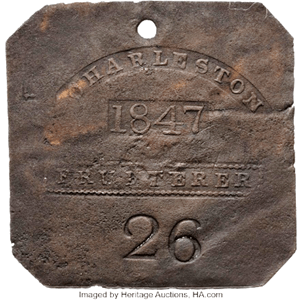
If fire wasn’t enough to worry about, I again googled the year 1847 that Reverend Dana mentioned twice as being problematic, to see if anything else was going on, like a plague. And while all the diseases thrived in Charleston, there was no particular epidemic. I did find two things specifically for Charleston 1847″. They seemed like two sides of one coin about the state of the city going on around the fires…fires that were set politically…
Slave badges served as the physical proof required to demonstrate the legal status of slaves hired out by their masters. Laws controlling such hiring began early, and badges or “tickets” were mentioned by 1751, with wearing them mandated by 1764. With its 1783 incorporation, Charleston immediately passed badge laws. Although other cities had similar laws, only Charleston badges have survived, suggesting that it may have been the only city to manufacture and sell them and to police their wearing. In 1800 laws became more uniform, and the earliest surviving badges known date from this year. By around 1806 badges were valid for a calendar year and were sold, at varying fees, in specific categories: mechanics, fruiterers (hucksters), fishers, porters, and servants. Most badges bore the geographic locator “Charleston.” All sported a category, a number, and a year. Surviving badges have holes for suspension since all slaves, except servants, had to wear them. Badges were made of copper of various shapes, depending on the design of the badge makers, who were appointed annually by the city council. Round, diamond, and square badges in differing sizes are known. Enforced until the end of slavery in 1865, badge laws required the keeping of records and the swearing of oaths by those purchasing them, and the laws stipulated punishments for failure to wear, produce, or buy badges. As many as one-quarter of Charleston’s slaves wore them in some years, and the income from badge sales added significantly to city coffers. By the end of the twentieth century, these throw-away items had become highly collectible, often selling for thousands of dollars.
Greene, Harlan, and Harry Hutchins, Jr. Slave Badges and the Slave-Hire System in Charleston, South Carolina, 1783–1865. Jefferson, N.C.: McFarland, 2004. Singleton, Theresa. “The Slave Tag: An Artifact of Urban Slavery.” South Carolina Antiquities 16, nos. 1–2 (1984): 41–65.
Reverand Dana does not mention the last year of this twelve-and-a half-year phase of church life…expect to say that he had to be absent due to ill health and the congregation continued to worship in the Archdale church until 1850…in Phase 3…



 Finding "My" Charleston...Digging down on the block I live on...to see what I can find.