This is the last of Reverend Dana’s Phases in the life of his church from the Charleston, SC News and Courier article I have been quoting written in 1873. We have followed the congregation of the Third Presbyterian Church on Archdale Street where they had begun in 1823 and their move to 273/5 Meeting Street at the corner of Society Street in 1850 and changed their name to Central Presbyterian.
Having moved from the outskirts of town closer to the center…a matter of a few blocks on a narrow peninsula…the pastor said that 1860 held “days of greatest prosperity”…as we saw in the last post. He was placing his church in the company of many Charlestonians who were living the high life over Christmas of 1860. As usual, there are a few things the Reverend doesn’t mention.
For instance, the presidential election on November 5, 1860…and, as we say today, elections have consequences…
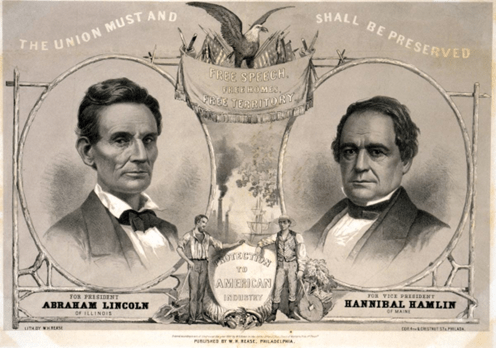
Abraham Lincoln Elected President (inspiredpencil.com)
“…at least true southerner Democrats were very worried that Republican Abraham Lincoln would win the election…which he did. “Every Southerner now feared that the North would stop at nothing to abolish slavery…By December 20, the Secession Convention convened in Charleston…vowing that the South and its “peculiar institution” must be preserved, the Ordinance of Secession was approved with a unanimous vote. Standing alone as the Republic of South Carolina, the state set about building up its military resources.
So, now Reverend Dana in the newspaper article noted above, addresses the year beginning his last Phase…
“…the fourth period from January 1861 to the present time (1873), including its days of darkest adversity…Now, we come to a period of calamity and affliction…”
The News and Courier Charleston SC July 14, 1873
Dana does not specify that on April 12, 1861, Charleston fired the first shot of the Civil War, firing on Union Fort Sumpter on a small island in the harbor.
Nor does he specify that on December 11, 1861, with war now in full gear, General Robert E. Lee visited Charleston.
“(W)hile rowing across the Ashley River to Charleston’s west side, General Lee and his staff saw a fire reflected in the distance from the peninsula’s east side. (The side facing the union forts.) Unaware that the fire would grow into a raging mass of destruction, Lee continued on to the Mills House Hotel at the corner of Meeting and Queen Streets.”
Charleston is Burning Two Centuries of Fire and Flames by Daniel J. Crooks, Jr, The History Press 2009 Charleston and London
Lee would soon have to be moved to safety. But his providential visit coincided with another fire known forever as The Great Charleston Fire of 1861.
The Great Charleston Fire Of 1861 | Lowcountry Walking Tours
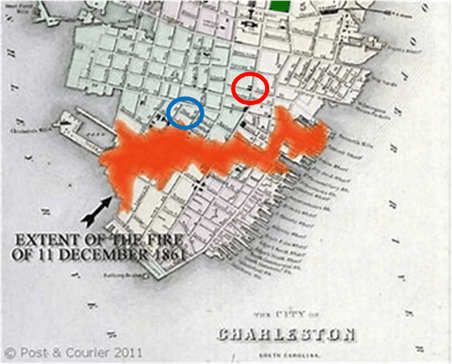
“The fire burned out of control until it had nothing else in its path to destroy. A path of demolition ranging from the northeast side to the southwest side pushed by a gale.” Charleston is Burning & The Great Charleston Fire of 1861 (above)
This fire spread coast to coast…entering the elite part of town. And the city was out of water to fight it. They had reservoirs under the streets to catch high tides for water to fight fires…but someone forgot to close the gates and they were empty.
I will quote a few lines from a sermon given by Reverend WBW Howe of St. Philips Church on December 20, 1861. It was his iconic 1700s church we witnessed burn to the ground in 1838 in a previous post:
The book of Job, my beloved brethren, is the book of divine Providence, and exhibits the method according to which the divine purposes manifest themselves in relation to me…What has God wrought or permitted to be wrought?
We could weep over the city. The heart aches as it thinks of the houseless poor, the destruction of mansions associated with the sacred past, the desolation of noble halls, the ruin of churches, and of the beautiful cathedral…was a pure delight every time you passed it. We say with Jeremiah, as we wend out way through the desolated streets, and in view of so many homes now, alas! In ruins: “Mine eye runneth down with water for the destruction of the daughter if of my people…
I am conscious of another circumstance, and one which has been present to all hearts, doubtless, which seems to make this calamity assume still graver proportions…coming at this particular time when we are threatened by an invasion from ruthless foes, and when our every nerve and muscle was strained to make a gallant defense…when all the necessities and comforts of life were more than usually difficult to procure…when for weeks and months past we had been earnestly engaged in ministering to the sick and wounded soldiers…when in every family the ruling question with the oldest and the youngest seems to be, What can I do for the good cause…
Oh, then at such a time of all others, for this destruction to be permitted to take place, appeared strange, yea passing strange, if God was indeed with us and upon our side…and so with us at present, we are being tried, not punished. God would prove what our faith is made of: whether it is a mere holiday-faith, which lasts only when the sun shines, and when all things are prosperous, or whether it is of that robust nature, which will endure a great fight of afflictions—which is the substance of things hoped for, and the evidence of things not seen…this is the very essence of the trial, to believe that God is with us when, to all appearances, He has deserted us.
Charleston is Burning, Two Centuries of Fire and Flames by Daniel J. Crooks
But Reverend Dana’s period of “calamity and affliction” was just getting started…
“Begun in the late summer of 1863, the Union bombardment of Charleston sent hundreds of shells cascading into the city. Explosions ignited flames that threatened to bring more devastation to a city already reduced to rubble.”
Reverend Howe, upon further thought decided that perhaps the Great Fire had been a good thing….
“It would seem that the hand of Providence intended this misfortune, for had not the fire happened many lives would have been lost in the bombardment of the city by the cursed Yankees, for thousands of their shells fell harmlessly in the burnt district which otherwise would have fell into the houses but for the fire.”
Only President Lincoln could have found any humor in the fact that the Ordinance of Secession that brought South Carolina out of the Union was voted on at St. Andrew’s Hall and signed into effect at Institute Hall, both of which were destroyed by the Great Fire of 1861. Charleston is Burning
Bombardment Of Charleston 1863-65
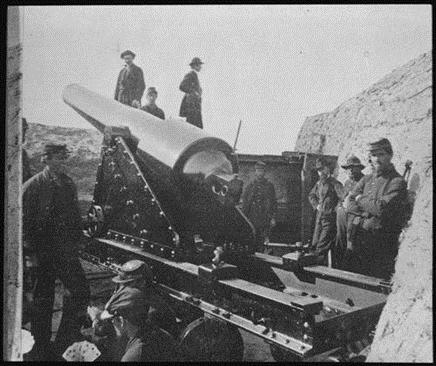
After an attack by Union ironclad ships in 1863 failed to gain control of Ft. Sumter (in Charleston harbor), General Quincy Gillmore set in action a plan to reduce Charleston with artillery fire into the city. The first of the shelling began in August 1863 from near Morris Island with the Swamp Angel, an 8-inch Parrott rifled cannon which could fire 200-pound incendiary shells (authorized by Lincoln himself) 4-5 miles into Charleston, ranging as far north as Calhoun St. (some a little further). After the Swamp Angel was disabled on its 36th round, the shelling was halted (with the exception of 3 rounds fired in October) for a few months.
Then in November of the same year, the shelling was renewed with intensity, forcing the majority of the population of the city to move north of Calhoun St. (northern boundary of city) to get out of range. This turned out to be fortuitous in that it reduced casualties among the civilian population. With this bombardment General Gillmore hoped to cause panic in the city and force the Confederate military to evacuate Charleston. This did not happen. Although this act of “inexcusable barbarity” (according to Confederate general P.G.T. Beauregard of Charleston) did cause some panic among the civilian population initially, over time it merely stiffened the resolve of the Rebels and civilians and for 545 days Charleston was on the receiving end of the longest bombardment in military history until the German siege of Leningrad in World War II.
Bombardment Of Charleston 1863-65 | Lowcountry Walking Tours
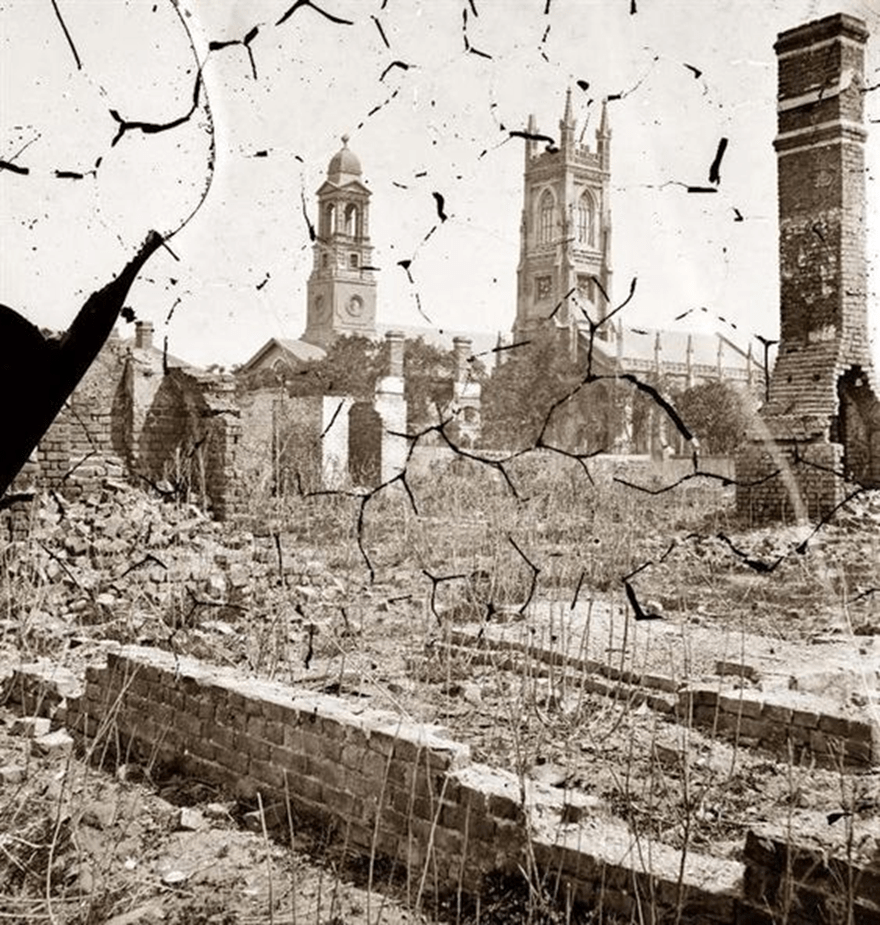
I have no pictures of Third Street Presbyterian Church in my parking lot for any time frame…but this photo dated 1865 is of one block south on my side of the street. Those are the same towers I see from my apartment window and in my parking lot photo, just from the opposite direction. As the fire maps don’t show that those churches or the old Third Presbyterian Church were damaged in the decade of fires in the 1830s, The Great Fires of 1861 came pretty close (see map with Archdale church in the blue circle) one might assume their original old wooden church was damaged by the shelling. The buildings still stood, though.
It is said that a good deal of the damage to the city that is attributed to the war was actually demolished by the fire. (The Unitarian Church tower…the first one you see in the photo…will be damaged in the earthquake about 15 years later and the tower will be lowered. Many of the oldest churches in Charleston lost their tower bells during the Civil War because they donated them to be melted down for the war effort.) and had major damage to repair.
Reverend Dana continues with what happened to his congregation and church in their new building…now 20 years old…on the corner of Society and Meeting Streets…
“Fully one half of the families attached to this church, in 1860, have removed from the city or State…There were but a few faithful members in the city, but they were constant… and it was purely an act of the greatest faith to undertake the revival of this church after the war. In the autumn of 1865, the interior of the building presented a ruinous aspect, having been disfigured by six shells….
“On the 1st December 1865, our services were resumed in the Second Baptist Church…”
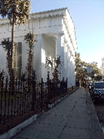
“1842 Second (later Wentworth Street) Baptist Church – 60 Wentworth Street Original building (now Centenary Methodist) erected 1842 Merged with Citadel Square Baptist Church June 1, 1868.” Illustrated Booklet of the Historic Churches of Charleston, South Carolina | David C Jones – Academia.edu
The temple style was popular…there are many churches like this still standing all around town. And it is the rare early church that did not have such moves and merging’s.
“On January, 1864, one of our number, with a magnificent liberality, advanced me funds sufficient to repair; and, in March,1866, with mingled emotions of joy and grief we came (back) to this, sacred place.
“During this period death’s visits have been frequent and made sad havoc. How many of our strongest pillars have we seen laid low! We who knew them can testify to their sterling worth—their noble manly virtue and generosity of disposition….and these men have left us a new church.
“It was God’s will that ten of our young men would be taken from us—five on the battlefield, and five from the ravages of disease. We have seen hours of gloom and sadness. We have buried, also, mothers, wives, daughters…Let us all endeavor to be faithful to the memory of those who have gone before us.
The News and Courier Charleston SC 1873
Which brings us back, sadly, to the Graveyard at the corner of Archdale and West Streets…where I began this venture…not knowing where it would lead…
From the newspaper article from 1953 says this:
“Mr. Halsey (an alderman who discovered the graveyard under a garbage dump) has been at some pains to piece together the history of the cemetery and former churchyard…ending with: “The church on Archdale …was demolished some time between 1850 and 1860. A few burials were made subsequently, but by 1870 all records indicate the site had been abandoned.”
The News and Courier Charleston SC 1953
As I’ve said in an earlier post, I could only find one name of someone buried in the graveyard on Archdale Street, an Irish woman named Jane Moorhead. But having the hint from Mr. Halsey, that there were a few burials in the 1860s, I kept googling. Looking at the Charleston County Library site under research, I eventually hit paydirt: The Ladies Memorial Association (Charleston, SC) 929.50975791, ccp 260899. As often happens a group of mostly ladies, took the time to go to cemeteries to record the names and dates on head stones in the small towns of America. This group went to cemeteries after the Civil War to record Charleston Civil War deaths…those that made it home to be buried here. They found two at the cemetery in my parking lot.
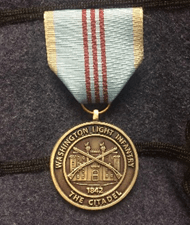
1863-4—Buried in Archdale cemetery—Caldwell, R Sharpter (Sharpshooter?), Private, Company B, Washington Light Infantry, died from wounds.
Dunn, Edmund, Private Company I 27th South Carolina Regiment died from disease contacted in service. Aged 32 years old.
CCPL Ladies Memorial Association, 27th South Carolina Infantry Regiment (civilwarintheeast.com)
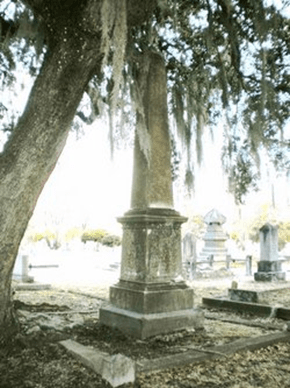
The Central Presbyterian Church on Meeting Street did not have a cemetery…the lot was too small. So, it is interesting to note that the church still used the old cemetery, at least for some of their burials after their move in 1850. But when Reverend William Combs Dana hailing from Massachusetts, died, November 1880 at 70 years of age, he will be buried in Magnolia Cemetery established also in 1850. While their were burials after the Civil War, Mr. Halsey was right to say that “everything indicates that by 1870, the Archdale Street graveyard was abandoned.” I could find no information to the contrary.
Oddly, though, there is a South Carolina Congressional Bill written just this year about the church. (Coincidence…ha.) I will let it speak to further evolution of the Third Presbyterian Church…after Reverend Dana retired…
2023-2024 Bill 4491: Westminster Presbyterian Church, 200th anniversary – South Carolina Legislature Online (scstatehouse.gov)
Whereas, founded in 1823, Westminster Presbyterian Church of Charleston is celebrating its two hundredth anniversary of gospel ministry in 2023…
Whereas, the church began at the corner of Archdale and West streets in the peninsula city as Third Presbyterian Church. Twenty-seven years later, the congregation moved into a newly constructed house of worship at Society and Meeting streets and in 1852 changed the church’s name to Central Presbyterian Church; and
Whereas, in 1882, following the death of Dr. William C. Dana, their paster of forty-five years, reduced in numbers and still struggling in the aftermath of the Civil War and Reconstruction, the members of Central Presbyterian Church merged with Zion Presbyterian Church on Glebe Street and changed the name of the church to Westminster, and
Whereas, the congregation would remain on Meeting Street until 1928, when, under the leadership of Dr. George Nickles, who served Westminster for thirty-five years, the church turned its attention to the residential development proceeding on the western edge of the city. Westminster sold its home on Meeting Street to Trinity United Methodist Church and constructed a new facility at Maverick Street and Rutledge Avenue. Knox Presbyterian Church and Community Presbyterian Church joined Westminster in this new undertaking; and
Whereas, through times of plenty and want, as well as war and natural disaster, Westminster has faced the future with the faith, hope, and confidence of a people who know that the God who has claimed them and called them also walks with them. It is with that same faith, hope, and confidence that the church again turns to the future, ready to answer God’s call to be and to make disciples who love God and love their neighbors; and
Whereas, Westminster Presbyterian Church has been a beacon of light and a community worship center in the Charleston area for two hundred years, and, God willing, will continue its godly heritage for many more years of worship and service. Now, therefore,
Be it resolved by the House of Representatives:
That the members of the South Carolina House of Representatives, by this resolution, congratulate Westminster Presbyterian Church of Charleston on the occasion of its historic two hundredth anniversary and commend the church for two centuries of service to God and the community.
Be it further resolved that a copy of this resolution be presented to Westminster Presbyterian Church,
—-XX—-
I was quite lucky to have found this document and could trace the Third Presbyterian Church through fires and bomb shells and later…not documented here…hurricanes and earthquakes through 201 years.
In the process, I have grown quite fond of Reverend Dana…all the hope and commitment to his church and his people…all the struggles of a small city caught in the cyclone of history.
I am going to give Reverend Dana the last word as recorded in that 1873 News and Courier article we have followed from the beginning…the church’s 50-year anniversary. They are the words of a man who has seen it all and knew the key to success on the early Charleston peninsula was for small and beleaguered remnants of whatever test was sent their way, to merge with others like them and carry on…
“And may the God who has watched over us with so much care, grant a peaceful end to our existence.”
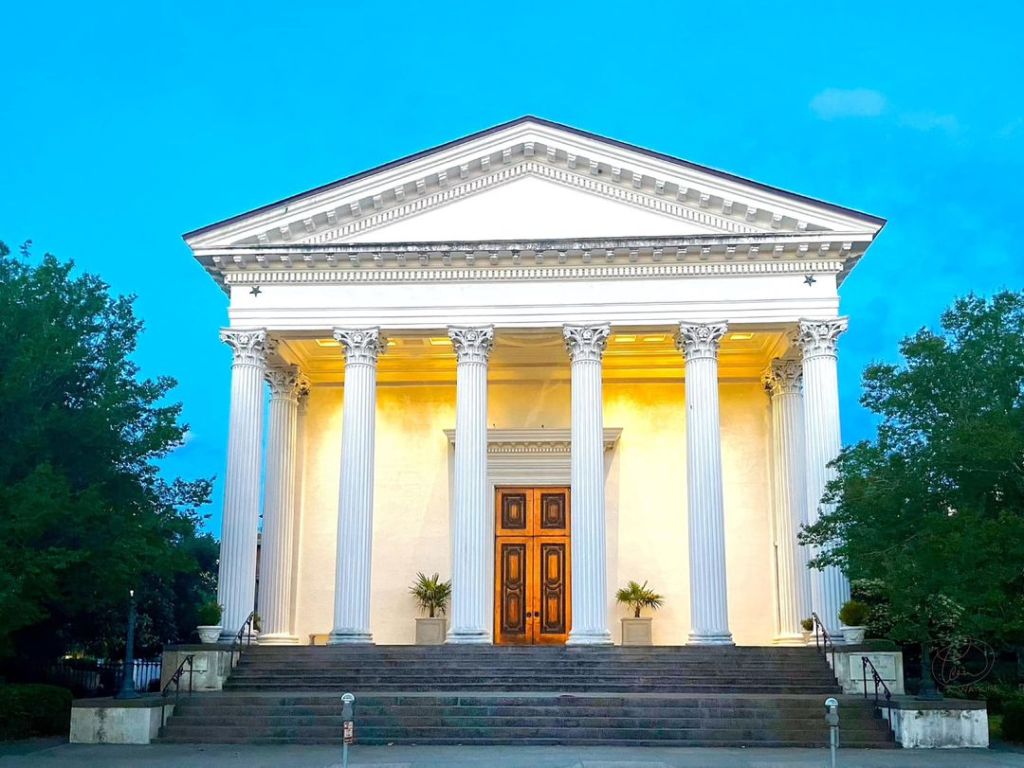
Just so you know…the Third Presbyterian’s new church, Central, became Westminster and when the Presbyterians moved out the Trinity Methodist Church moved in 1929. They are still there and the church is looking fine…
Photo by Larry Watkins, my favorite Charleston photographer who post pictures of the houses and churches around town…one every single day. Here is his site on FB. https://www.facebook.com/groups/582384303032983/ He posted this photo of “Trinity Methodist Church” this week…coincidence, I think not…
 Finding "My" Charleston...Digging down on the block I live on...to see what I can find.