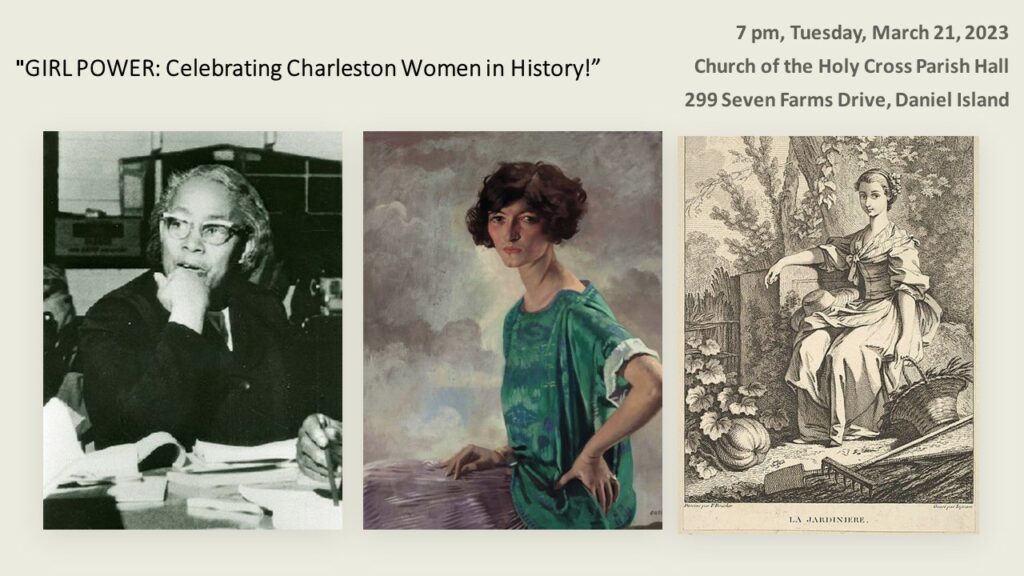
Like with the history of the slaves in Charleston, much work has been done also on women. My little bit of history writing eventually settled on telling the stories of the local women. As I’ve said before, most early history books of the early days of most American cities and towns are written to a formula of the citizen/man and all he did, his wife’s name, her father’s name, rank and serial number of how many children she had before she died. That is only a very slight exaggeration.
Writing about the history of my block was a bit of a departure but now I want to again highlight a few women who lived in the neighborhood of Market and Archdale Streets I had run across…including one woman who owned a plot of land directly under Canterbury House.
But I confess to harboring a bit of a prejudice about the Civil War and Charleston’s role in it. St. Charles, MO, where I worked in the county’s historical society’s archive, offered me early first-hand information on slaves there…with a little digging. But Charleston seems like the epicenter of that war and all that went with it, and I didn’t want to go there, though I did address the effect of the war on the neighborhood and the church on my block. That was safe enough and got my toe in the door, as it were.
Once I decided to get back into writing about the women, I did what I always do…I went to library and Thrift Books websites and searched for Early Charleston Women…and hit it big…

I found “Our Women in the War”, The Lives they Lived; The Deaths They Died. It is a much thicker book than I expected. It is a compilation of actual copies from the newspaper articles written by women of their experiences in the Civil War. The stories of South Carolina women were requested by the Weekly News and Courier, Charleston, S.C. and was published in 1885, printed by the News and Courier Book Presses. I ordered it immediately, of course. (And later learned that the Charleston County Library has it and can be checked out. Thrift Books only had 2 other copies available.) The stories are from women all over the state with only a few from Charleston itself…but oh boy. When I get to that timeframe in my women’s series, I will share excerpts from two or three of the women’s stories.
I learned, though, by reading the first two Charleston stories, that those pre-war and war days were in many ways similar to today in America with our vastly divided loyalties and visions for what we want our country to be. Recognizing that, I gave myself permission to proceed.
But it will take a while to get there…we have a few women to learn about first…understanding their lives will set the stage for all that comes after…
Cleta
 Finding "My" Charleston...Digging down on the block I live on...to see what I can find.