I have decided to go back to the beginning with a slightly different focus; early women in my neighborhood. While my block was quiet or at times should have been…my neighborhood was not. In fact, luckily for me, there is a woman who is locally well known for being a first settler on the first ship that landed at what was first settlement at Albermarle Point across what would be called the Ashley River from present day Charleston. We know a lot about her for a woman. She lived two blocks over on Wentworth Street at the end of her life…and before she died she helped shape this/my part of Charleston…
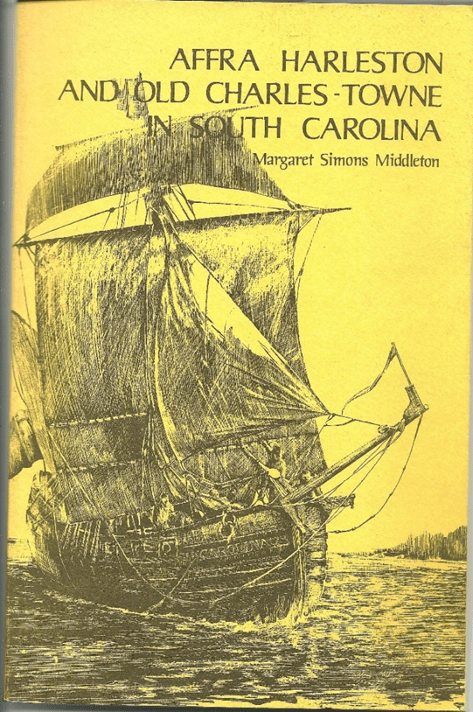
When I first started researching Charleston, I serendipitously found this 55-page book online. There was only one of them left and it cost me less than $5. (If you live in Charleston or know its history, you know the author’s names of “Middleton” and “Simon” and “Margaret” in many family variations.)
The book was published in 1971 with a romantic historical fiction beginning plus the text of many of the earliest documents on the first settlement, as well as excerpts from a personal letter written by Affra herself.
When one researches Affra, one quickly learns that there are two versions of Afra’s story, like there are two spellings for her first name. Both versions of her story are also very similar except for one detail…
Chapter One…
A young woman of about eighteen years was walking through the main street of Gravesend in August of 1669…
She spoke to a young boy approaching her. “If you please, can you tell me how to arrive at the three ships preparing for the voyage to Carolina?…”
Eventually she arrived at the frigate Carolina and asked to see the captain who was astonished as one as high born as her wanted to go…he admonished her to go back…
“I’m going, Sir, because…I can’t go back sir, I took my mother’s last five shillings, and I have to make the family fortune.”
“I see…” He blew a whistle and the sailor appeared. “Take this lady to Mr. Coming and tell him I have written down her name but not the sponsor. Have him attend to that and give her all the conditions. She seems not to know them.”
Afra followed the sailor and…reached the mate…who was a large, broad-shouldered man with a pleasant smile on his swarthy young face.
“Does your father know you are on this ship?
“No, Sir.”…
The mate saw she was on the verge of tears “I see. It’s a pretty kettle of fish ye are in, and I won’t argy with ye.”
“Thank you, sir, thank ye…I can go on the boat with ye?”
“Yes, if ye can get yourself a sponsor.” He turned to the ship’s boy. “See if Mr. Hollis or Mr. Dalton are on board ship. They want a few more women.”
“For what?” Affra was astonished. “I don’t want to sign up with strange men!”
“You have to, if ye have not the purchase money for the trip. They pay for your passage and food, and they get on the other side 150 acres of land for each person they sign up for two years. When your two years are up, you will get for yourself 100 acre to use as you please, plant, rent, or sell.”
“I did not know about that. I don’t want to sign up to any man!”
“Then go back home as I advise ye.”
“I can’t go back home to my mother! I stole her money…What can I do”?
“I don’t know; it’s your business. Here’s Mr. Dalton.”
Mr. Dalton was a quiet, scholarly-looking man, who was later to be secretary for the colony for many years.
“What can I do for you, Mr. Coming?” He regarded Affra indifferently…
“This young lady wants to sign up for Carolina and I know you wanted several more woman for your list.”
… “Can you work? He turned to Affra.
“Yes, Sir.”
“Can you work in the fields:”
“Oh, yes, Sir,” said Affra hesitatingly…
“Well, Affra, I hope this voyage is a good one for both of us. Good day. No doubt I shall see much of you on this trip.” He turned to the mate, “You feel sure she knows the conditions?”
The “conditions” are the mystery. Did she know what was in “the fine print” or not? Because she did arrive in Carolina as an indentured servant.
We do have a good source for her life from her extended family’s well-documented history researched and written by a descendant: Slaves in the Family by Edward Ball, Farrar, Straus and Giroux New York 1998
1669
Affra Harleston (c. 1640s-1699) was born into an affluent landed family from Essex whose fortunes fell on hard times following the English civil wars of the mid-17th century. Supporters of the unfortunate Charles I, the family moved to Ireland to escape Oliver Cromwell’s wrath after Charles’ beheading. Affra was probably born there in the mid-to-late 1640s; some sources say 1651. For unknown reasons, she boarded the Carolina during its first stop in Ireland seeking a new beginning. Slaves in the Family
We can note here that Middleton’s book began with Affra being about eighteen years old but the extended family’s estimated birth date (above) for her would have her be about 29-30 years old for the voyage. Her being older would have helped her face the virgin wilderness she will confront.
Continuing with Slaves in the Family…The mate in Middleton’s story, Mr. Comings, came from Devon, the port the Mayflower left England from in 1620. It was his first time out as first mate.
John grew up in Devon and had become a sailor. In 1669 he signed on as first mate to the Carolina, a ship commissioned by investors to make the first permanent English settlement on the southeastern coast of North America. Unlike earlier attempts, the expedition succeeded. John married Affra Harleston, one of the few women aboard his ship, and returned to sea. He rose to the rank of captain and made round-trip voyages…Slaves in the Family
We can now look to another favorite source of mine for perspective: A Short History of Charleston by Robert Rosen, University of South Carolina Press 1982, 1992
1669-1670
In the beginning the group that came to “Carolina” on a ship named “Carolina” were upper class Englishmen, friends of Bonny King Charles the II known far and wide for his love of the good life and all it entailed. The men who led the expedition sought to quickly establish themselves in money-making ventures and replicate the good life. They had the designation of “Proprietors” and their names are on rivers, neighborhoods and roads. The development was a business venture…to ship new world products to old England and get rich doing it…as opposed to early religious colonies up the coast.
When they arrived in the new colony of Carolina in early 1670, the colonists followed in the path of Robert Sandford, an explorer sent earlier by the Lord Proprietors. Sandford had originally landed in what is now the North Edisto River, and the official ceremony by which England claimed Carolina had already taken place…Sandford had befriended the Kiaway Indians and had visited with their chief (Cacique)…He described it as “divers fields of maiz with many little houses….” It was Cacique of the Kiawahs who urged the English to settle on their lands. …(T)he colonists discussed whether to locate Charles Town at Port Royal (the original destination they did not make it to) or on the Ashley River.
“The Governor adhering for Kayaway & most of us being of a temper to follow though wee knew noe reason for it.” So, for no ascertainable reason with no overall plan, at the insistence of an unknown Indian, the colonist moved to the lands of the Kiawah, on the Ashley River to establish Charles Town and Carolina.” A Short History of Charleston
Back to the Middleton’s Affra book and copies of early documents:
In a letter written by Stephen Bull on “12 Sept 70”. He spoke of May of that year when the “Carolina” set sail to get more provisions for the new colony they had dropped off…John would have just enough time to put up a small cabin before leaving…
“May it please yo’ Honor when the Ship Carolina departed hence about the 26th of May last she left us as wee conceived about 10 or 11 weeks Provisions of Peas and a small quantity of wheate and Oatmeal very inconsiderable at a quart per diem for a man & within 15 or 16 days after the ship’s dep’ture we overhauled our stores of Provisions and we fond that there could not be made up about 2 month Provisions at a Pinte of Peas per diem…We found very great Assistance from the Indians who showed themselves very kinde and sould us Provisions att very reasonable rates & taking notice of our necessities did almost daylie bringe one thinge or another otherwise wee most undoubtedly have been put to extreme hardships…”
It became apparent from the first days that the settlers needed more help. It was simple. The landowners and those employed by the Proprietors were under tremendous stress both for their own survival but also to produce crops and cash resources to ship back to England to keep the Proprietors happy. They desperately needed help.
On August 3, 1670, five months after the original settlement, the first slave was brought to Charles Town from Virginia. He was described simply as “one lusty negro man.” A few weeks later, three other slaves arrived from Bermuda…A Short History of Charleston
The second thing the settlers discovered was that their site up the Ashley River was not a suitable port for large ships to come and go…
1671
On August 1671, a parliament was held…The early settlers explored the area through the early 1670s to ascertain whether another site for the town would be more desirable, and at least as early as February 1672 they had decided to move the town from Albemarle Point to Oyster Point.
And “to build their town which they first called Charles Town…By 1672 Charles Town consisted of 30 houses and 200 people… A Short History
All versions of Affra’s life say that she married Mr. Coming the first mate on the Carolina, but…
1672
…The date of the marriage of John and Affra is uncertain, the secretary Mr. Dalton probably performed the ceremony as he was commissioned to do…when her two years of servitude to Mesrs . Hollis and Dalton were up. The mate, John Coming who made a salary of three pounds a month could not have paid for her time to her “masters,” as the two men were described. Middleton’s Affra book
Some think that Afra and John had a first home on the grid of the first Charles Towne at Albemarle Point. John may have had land there, though he is not mentioned on the first list of land distribution or on the hand drawn map included in Middleton’s book. (Small print going in both directions. I could not find “Coming” or “Harleston”…I could not find an attribution for the map but the writing on it is from about that time…)
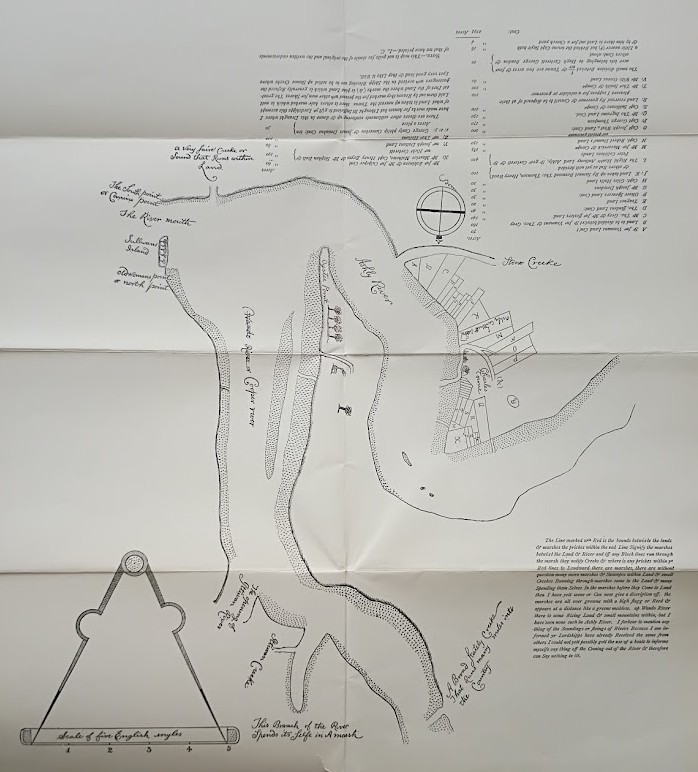
by Margaret Simons Middleton 1971
Afra was indentured until sometime in 1671 and John was away almost constantly from 1670 to 1672…but it is speculated that he had hastily put up a cabin. The next mention of them in the early papers was in 1672 after Affra’s two years of indenture were up and she must have had land to work with…perhaps her 100 acres for her payment for service…because she was already dealing with her own indentured servants…
(Affra and John)…had three bond servants…Those servants were John Chambers, Philip Onill, and Michael Lovell. We learn much of the courageous character of Affra Harleston from the way in which she handled these servants when her husband went on one of his trips and left her to manage the plantation. The story is to be found in the records of the Grand Council and will be given as found there:
“At a meeting ETc this 4th day of June 1672 sitting Etc. (all) Upon consideration had of the complaint this day brought in by Mrs. Affra Coming against her servants namely John Chambers, Phillip Onil and Michael Lovell for their disobedience to her in refusing to observe her lawful commands & more especially against the said Philipp Onill for threatening to overset the Boate wherein she was or words to that effect and giving the provisions allowed him to the Doggs and threatening to run away to the Indians & divers other gosse abuse & destructive practices which being sufficiently proved It is ordered by the Grand Council that the said Philipp Onill be forthwith tied to the tree and there receive one and twenty lashes upon his naked back and the others be advised for time to come to render more dutiful obedience to the lawful commands of their mistress on paine of condigne punishment.”…(1)
(“The Tree” was often used as a place of punishment as it is referred to so casually here and elsewhere.)
The next notice we have of John and Affra Coming was when as a man and wife on Sept. 8th, 1672 they appeared before the Grand Council and relinquished the land Coming had been granted at Oyster Point as it was no(w) needed for the new town planned there. John Coming continued to work as a ship’s mate for many years. He was greatly praised by Capt. Brayne and eventually the Lord Ashley put him in command of his ship the Edisto… Middleton’s Afra Book
And now, we learn more of the colonist’s biggest problem one faced by all the early settlements and colonies and hinted at with the trouble Afra had with indentured servants, reliable help with the work.
Throughout the1670s
On August 3, 1670, five months after the original settlement, the first slave was brought to Charles Town from Virginia. He was described simply as “one lusty negro man.” A few weeks later, three other slaves arrived from Bermuda…A Short History of Charleston
…John and Affra Coming probably were not involved in the slave raids, but Coming was almost certainly a slave trader of sorts, transporting people in and out of the colony. Soon after the first landing in Carolina, he gained the captain’s berth in a ship called the Edisto, and afterward another vessel, the Blessing. As one of the settlement’s chief mariners, Coming earned his living by shuttling cargo between Carolina and other English territories. Throughout the 1670s, when he was almost constantly at sea, it is likely that beneath his decks…he…carried Native people out of Carolina to Barbados, and Africans from Barbados back to the mainland. Slaves in the Family Slaves in the Family by Edward Ball, Farrar, Straus and Giroux New York 1998
Early in the 70s, though, the settlers were still in need of help…four black slaves were not enough. Though the Kiawah nation invited the settlers in and helped them survive the first hard years, the settlers had severe responsibilities to the Proprietors. The early documents record both sides frustration. Finally, the settlers began to make raids on the native villages to take men and women captives for slaves. This will lead to early raids against the settlers, that will continue to grow into a full-blown Indian war in the 1700’s.
Indians, too, threatened early Charles Town. There was war with the Westoe Indians in 1673 and with the Stono Indians shortly thereafter. Short History of Charleston
1675
…In 1675, when the colony at Carolina was five years old, its affairs apparently came to a crisis. The Proprietors in England balked at the expense. The people there had made no adequate return for the 5000 to 6000 pounds invested by them; in addition, they had accumulated great debts…and made too many demands like: Send horses for their plows. What did the Proprietors get in return for their expenses? A number of ship masts and barrel staves and barrels of pitch and tar. What could those fine gentlemen dressed in curling wigs and silk garments do with such things? They were not tradesmen selling such products. Their expenses had to stop. They had gone into this business for profit, not charity, and they did not intend to have these colonists live off them for life as they seemed to think they could…A Short History of Charleston
1679
… On December 17, 1679, The Grand Council decided that Charles Town would be moved to Oyster Point, and, in the spring of 1680, the town was moved back down the Ashley River to a site just north of the large, gleaming, white oyster bank that the original settlers had passed on their journey up the river in 1670. By 1682, there were 100 houses at the new site…A Short History
1680s
In about 1682, when John decided to retire from sailing, he requested and was granted by the Lords Proprietors 740 acres of land for a plantation. Since John had already been granted 850 acres from the six servants he brought to Charles Towne, this additional grant, plus the peninsula property, increased the couple’s holdings to over 1600 acres.
A new source: Affra Harleston and John Coming: Carolina Pioneers – Symbiotic Thoughts
After scouting around the area, the place where Affra and John chose for their plantation was north of Charles Towne some 15 miles up the Cooper River at a point where the eastern and western branches of the Cooper come together. The merging of the streams at their plantation formed a ‘T’ in the topography, prompting John and Affra to name their new plantation ComingTee. He also named a part of the land ‘Blessing’ Plantation after one of the ships he had commanded.
John and Affra experimented with a number of crops and discovered that the area was well suited for rice cultivation which was just getting started in Carolina. By the late 1680s, rice was becoming an important cash crop in the Carolina low country, and ComingTee was well located for that crop, far enough up stream to where the river water was fresh but low enough downstream that there was still the rising and falling of the tides that pushed the fresh water into the rice ponds at high tide and allowed it to drain out when the tide ebbed.
Back to Slaves in the Family…
In the 1680s the couple built a substantial wooden home at ComingTee which apparently was still standing in the 1900s. They also continued to maintain their home in Charles Towne.
The estate where John Coming lived was known as Coming’s T. It stood on a river where two tributaries came together in the shape of the letter T…grand 740 acres…peopled by captive workers, African and Native American slaves. Slaves in the Family
Charles Town
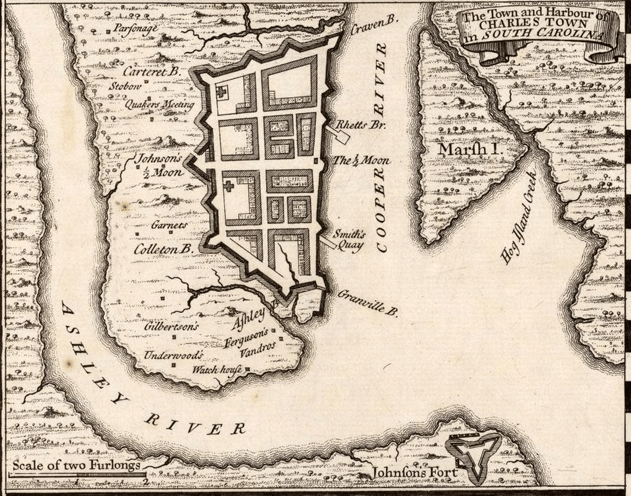
The town was bounded by present day Meeting Street (on the west). Broad Street (on the north), and the Cooper River on(on the east). The land to the south was variously called Comings Point (for John Coming who had owned it) or White Point (“no doubt from the whiteness of the oyster shells upon it”) The early city was bounded on three sides by water: on the east by the Cooper River; on the north and south, by large creeks, and on the west by a wall.”
1686 Early Charles Town, constructed as a fort, was also plagued by war. “Settled in the very caps of the Spaniards,” it became a military objective of the Spanish from its first days. In August 1686, there were 150 Spaniards, Indians, and mulattoes outside the city preparing to attack. Because the militia organized and a great storm came up, the invaders withdrew. A Short History of Charleston
Now back to Affra and Middleton’s book…
1694
And now we return to the last years of John and Affra Harleston. They had been years of great achievement. Capt. John Coming was now gentleman and esquire and a member of the Grand Council…Coming died August 20, 1694 and in his will left all his estate to his wife whom he also appointed executrix….
“After her husband’s death Affra Coming was soon alone by herself…Affra, feeling death’s approach after the death of her husband, in 1694, may have then come to New Charles Town and lived in one half of the double house on the southwest corner of Wentworth and St. Philip Streets. Tradition pointed out to the writer that this house was built by Affra Harleston and it is possible she had it in mind as a tenement building for the two nephews to whom she and her husband had decided to leave their property, to John Harleston, gen. and to Isaac Ball, in joint tenancy. Middleton’s Affra book
First Settlers Second Generation
John’s Coming’s nephew Isaac took over ComingTee and became a force in the plantation world up the Cooper River. It is his descendent that wrote the book Slaves in the Family I have been quoting from that documented so well the plantation owners, families, and slaves in Charleston’s plantation and slave owning days…but I am interested here in the other story; the story of my neighborhood, the part of Afra’s will and the grant to John Harleston, Affra’s nephew.
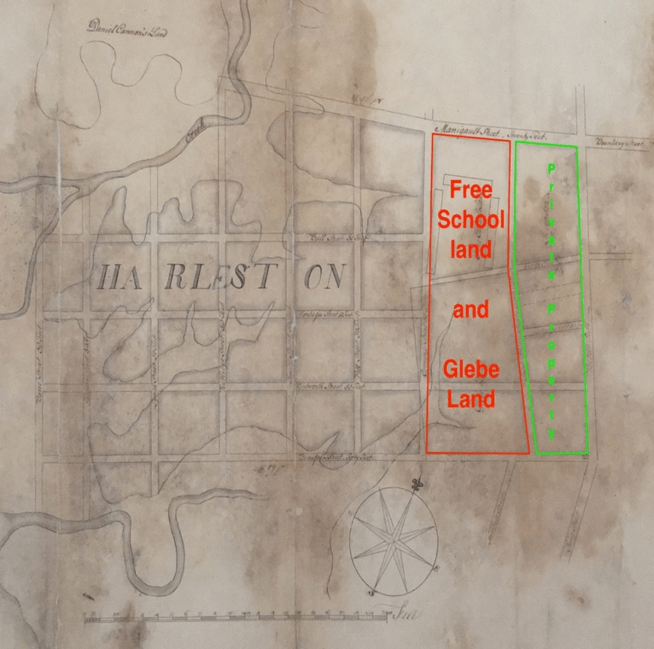
John Coming and Henry Hughes received grants for over 319 acres of the land in 1671, and it later passed to the Harleston family through marriage (Affra Harleston married John Coming, and she donated a parcel of land to the Anglican Church to generate rental income — the origin of Glebe Street). The area was rural pasture lands and marshes owned by the Coming and Harleston families in the colonial era and was outside of town…The Genesis of the Harleston Neighborhood, 1672-1770 | Charleston County Public Library (ccpl.org)
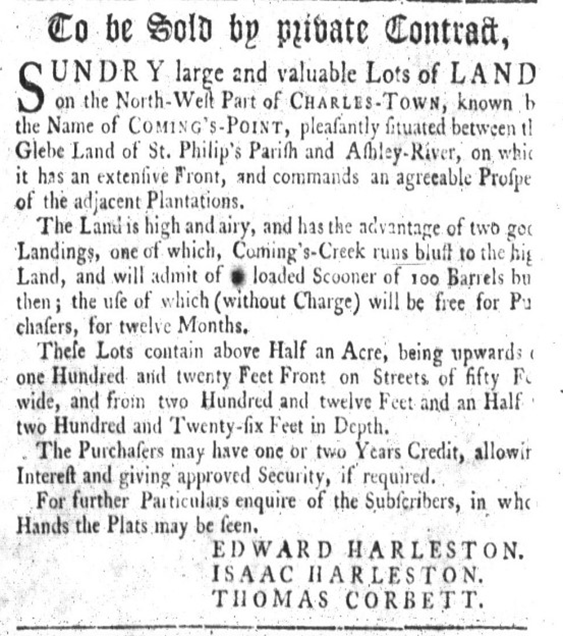
Several years later, John Harleston of Dublin married Elizabeth Willis here in 1707, and the couple became the parents of one daughter and six sons.[3]
The lack of detailed family papers frustrate our ability to understand how the Harlestons made use of their large tract of land on the northwest fringes of urban Charles Town during the first half of the eighteenth century, but I have found one clue that might provide a convenient synopsis. In the early months of the year 1750, Elizabeth Harleston, the widow of John the immigrant, advertised in the local newspaper to rent out a tract of 130 acres next to Charles Town. She described the property as “a convenient pasture (for either a butcher or inn-keeper),” which recently had been leased to Mrs. [Mary] Eycott (the wife of a proprietor of a tavern and stable). It would appear, therefore, that the Harlestons did not establish a residence on this land, but rather used the large riverfront property as a grazing pasture for horses and cattle for many decades. Situated on the northwestern outskirts of the colonial capital of South Carolina, and accessible from the Ashley River, the Harleston property was well suited to provide necessary amenities to the people visiting and working in urban Charles Town.[4] The Genesis of the Harleston Neighborhood, 1672-1770 | Charleston County Public Library
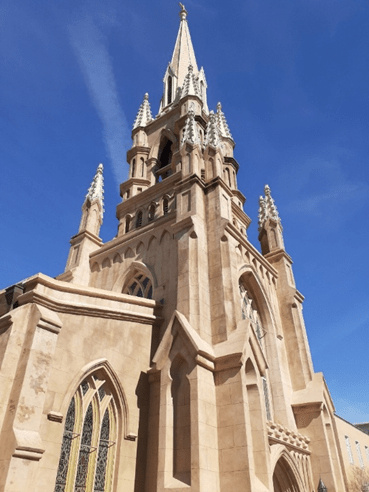
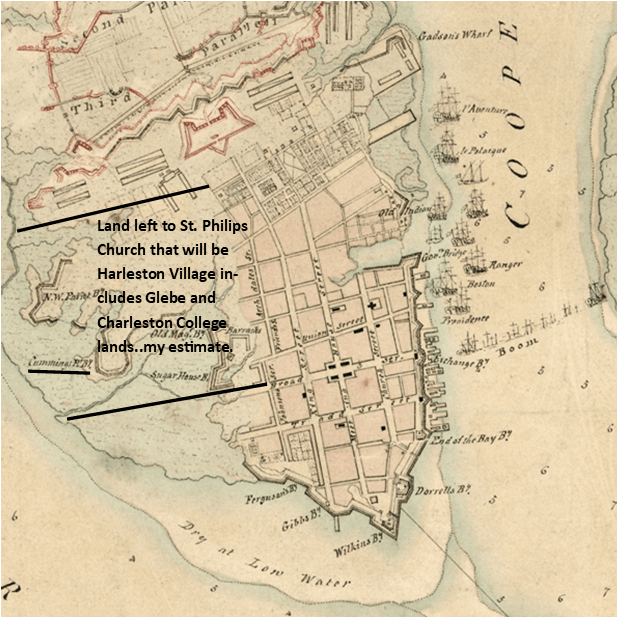
Harleston…not always called Village…became the parsonage home of St. Philip’s Episcopal Church on Church Street…the oldest continually open church on the peninsula. Harleston, because of the Glebe lands became the home of many other churches as well as the home of Charleston College when the church later gave land to the school…one of the oldest colleges in the South.
Grace Episcopal Church is on Wentworth Street between St. Philips Street and Coming Street. The church membership has been valued supporters of Canterbury House with Sunday Teas and a bag supper one night a week. They are about two old town blocks away from Canterbury and very close to where Affra died.
The church has a stone in their front yard commemorating the life of the woman who gave the land to St. Philip’s Church.
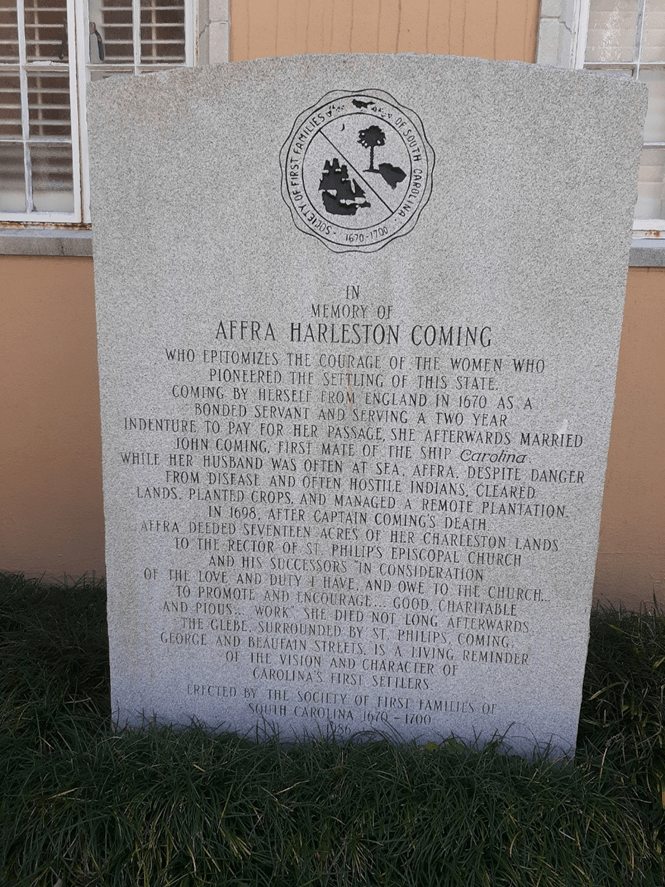
This memorial stone, honoring the memory of Affra Harleston Coming, can be found on the grounds of Grace Episcopal Church on Glebe Street. Its inscription reads:
In Memory Of
Affra Harleston Coming
Who epitomizes the courage of the woman who
pioneered the settling of this state.
Coming by herself from England in 1670 as a
bonded servant and serving a two year
indenture to pay for her passage, she afterwards married
John Coming, First Mate of the ship Carolina.
While her husband was often at sea, Affra, despite danger
from disease and often hostile Indians, cleared
lands, planted crops and managed a remote plantation.
In 1698, after Captain Coming’s death
Affra deeded seventeen acres of her Charleston lands
to the rector of St. Philip’s Episcopal Church
and his successors “in consideration
of the love and duty I have, and owe to the church…
to promote and encourage … good charitable
and pious … work.” She died not long afterwards.
The glebe, surrounded by St. Philips, Coming,
George and Beaufain Streets, is a living reminder
of the vision and character of
Carolina’s first settlers.Erected by the Society of First Families of
South Carolina 1670 – 1700
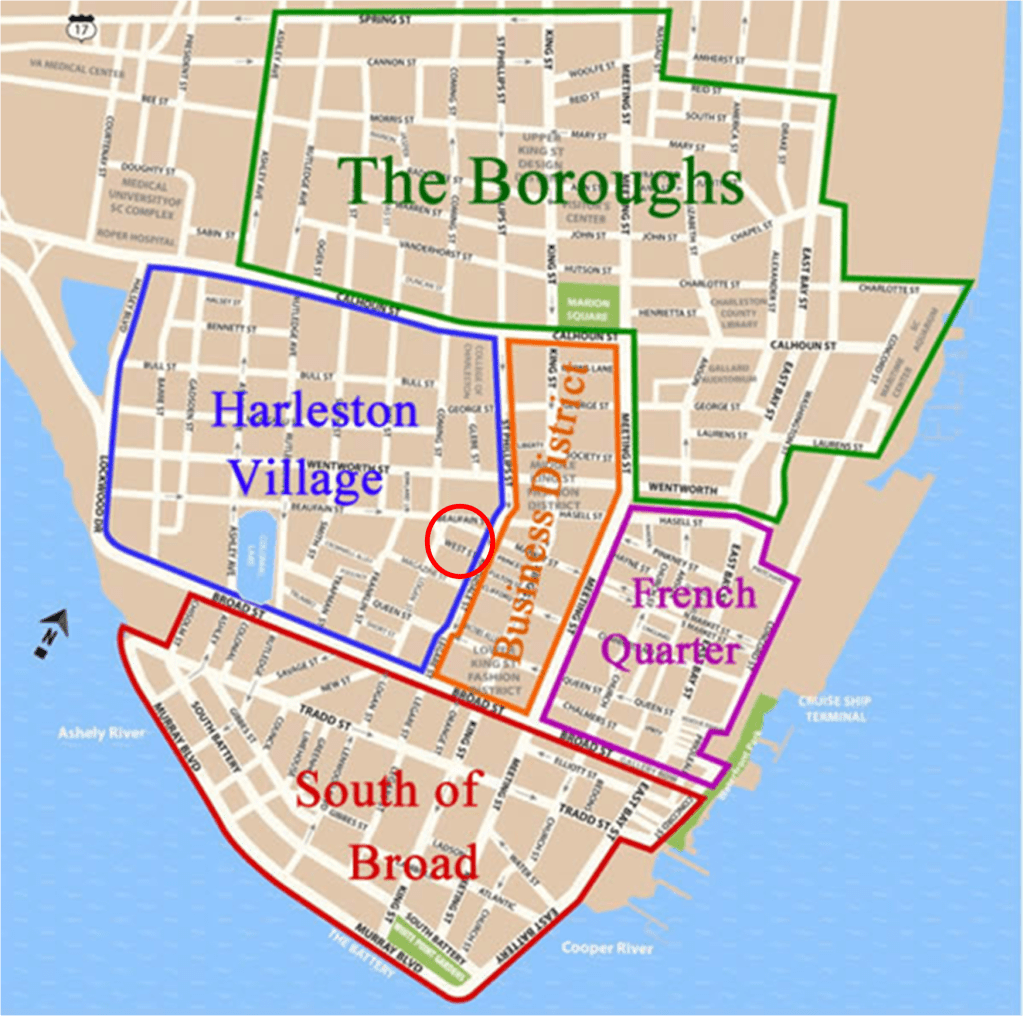
By the mid to late 1800s a lot of the marsh will have been drained and filled in to make room for more homes. Eventually, the city will put roads through, and accommodation were made…and come to find out…I live in Harlston Village according to the map below. Across Archdale Street toward King Street is considered to be Old Charles Town and the Business District. On my side of the street, we are Harleston Village…I’m good with that…having an English/Irish genealogy with the (married) last name of Flynn….and even better, I was able to bring Affra’s story back to me…lol. (2)
Note 1: You will notice that the men’s names were Irish. John Coming would get paid by how many Irish indentured servants he would bring over…including their own, it seems. While writing this post I ran across an article written on the early colonies using Irish men as their first round of slaves and how a good many African women had half-Irish babies…including Kamala Harris. Here’s the link:
Note 2: I am a firm “believer” in what Quantum Physics began telling us in the 1970s and 80s…The observer/researcher finds what she is looking for…herself or her preconceived but strongly held ideas…and the miracle part is that there IS something to find.
 Finding "My" Charleston...Digging down on the block I live on...to see what I can find.
One response to “In the Beginning…Affra Harleston Comings 1670-1698”
[…] set the stage: Affra Harleston Coming, an original settler, died in 1698 and Eliza’s letters actually begin in 1779…81 years […]
LikeLike