Creator of the Charleston Unitarian Church Graveyard among other things

Charleston’s old Unitarian graveyard is a popular tourist site for two reasons: One, the grounds are left more or less to nature with minimal control by volunteers. And two, it is haunted. I will add links if you are interested in more…a great story about Annabel Lee and her lost lover Edgar Allan Poe.)
And, as odd as that is, the graveyard/churchyard is a good introduction to the next woman on my list. Caroline Gilman designed the yard and left strict orders that it was to be kept in a natural state.
“She was inspired by Mount Auburn Cemetery in Massachusetts, to create the churchyard next to the church in the 1830s with beautiful plants and objects; a place to be used by the living.” Caroline Howard Gilman – Wikipedia
But there was much more to Caroline Howard Gilman than that…

“Just as Eliza Wilkinson was a Revolutionary War patriot against the rule of kings and was affected by the Boston Tea Party, young Caroline Howard’s father Samuel “was one of the original ‘Indians’ in the Boston Tea Party…no tax without representation…the triggering rebellion against British and King-rule.” Caroline Howard Gilman (1794-1888) – Find A Grave Memorial
(It seems a little coincidental to be working on this article at the time of the “No Kings” protests.)
I will quote and sometimes paraphrase from several great articles on Caroline’s life…with links provided.
A (Woman!) Writer in old Charles Town
Caroline was born in Boston in 1794 and lost her parents early even her Patriot father. She was raised by her older sister, and they were moved around among relatives most of her young life. Caroline did not have a stable home, probably prompting her…by 1810…to begin writing. She did it secretly as young girls do.
“However, the same year a Boston newspaper published “Jephthah’s Rash Vow” a poem her family had secretly submitted. The sixteen-year-old later reminiscing stated she was ‘as alarmed as if I had been detected in Man’s apparel.”
At twenty-five years old, in 1819, Caroline married brand new minister Samuel Gilman, a graduate of the Harvard Divinity School. They moved to Charleston, South Carolina, six weeks later. Gilman had been offered a position as minister to the Unitarian congregation. The 1700s church already had an interesting beginning as an Independent Church in an Episcopalian town. The original church was built on the outskirts of the old walled town. The congregation while probably leaning Unitarian will not officially make the change until twenty years later. By then the fortress walls were down and the town was expanding around the church.
Before her first child was born, Caroline wrote some hymns for the church:
“Is there a lone and dreary hour?” (Providence.) Contributed to Sewall’s Unitarian Collection, New York City, 1820, in four stanzas of four lines. In 1867, Gilman added a stanza thereto for the Charlestown Services & Hymns. The original hymn was in extensive use amongst the Unitarians in Great Britain and the United States. “We bless Thee for this sacred day”. (Sunday.) Also contributed to Sewall’s Collection, 1820, in four stanzas of four lines, to which another was added by Gilman, for the Charlestown Services & Hymns, 1867. In extensive use.” Gilman, Caroline Howard | South Carolina Encyclopedia
Caroline stopped writing hymns when she began to have babies. She will spend the next 10 years having children and learning to be a good Southern wife and housekeeper/homemaker/mother. She will have a total of seven children, four living girls and three babies that died at or shortly after birth. Her living girls: Abby in 1820, Caroline in 1823, Eliza in 1825, Annie in 1829. A girl child died at birth in 1831. (A boy child will be mentioned 10 years later, and earlier she possibly had one more child that didn’t make the histories.) It was the death of the child in 1831 that sent Caroline back to writing.
“From 1832 to 1839, as a wife and mother, she turned her attention to publishing and editing a newspaper for young readers and their families called the Rose-Bud or Southern Rose-Bud and finally, the Southern Rose. In this publication Caroline (later) serialized much of her work, including the novels Recollections of a Housekeeper (1834) and Recollections of a Southern Matron (1836), both chronicles of domesticity that attempted to show the similarities between households of the North and South, while also stressing the importance of home and hearth.
“Gilman believed in the power of the family and in women as its moral center. She was convinced that a wife’s most important duty was to act with deference in relations with her husband in order to secure domestic tranquility. Gilman counseled women to hold their tongues and to maintain self-control. She hoped that in attracting both northern and southern readers to her work, she could somehow extend the peace and tranquility of the home to the entire fractious nation. It was a simplistic notion that, like her growing popularity as a writer, would not last beyond the war.” Caroline Gilman
All articles and researchers of Caroline’s life include slightly varied lists of her published works…
From 1832 to 1842, she published the first American weekly journal for young people, “Rose Bud” (later the Southern Rose), which circulated from Massachusetts to Georgia and made her the best-known woman writer of the South. Humorous sketches about the management of a middle-class household and its servants, written for the Rose were published in 1834 as “Recollections of a New England Bride”. Also in 1934 the first of her volumes “Recollections of a Housekeeper” humorously described the little vicissitudes of early married life. Gilman attributed its great popularity to the fact that “it was the first attempt, in that particular mode, to enter into the recesses of American homes and hearts.” Other publications include “Recollections of a Southern Matron” in 1837, a chapter of which English journalist Harriet Martineau included in her “Society in America” in 1837; “The Lady’s Annual Register and Housewife’s Memorandum Book, 1838, a manual for housekeepers…Find a Grave
Caroline’s husband, Samuel Gillman, was a bit overlooked because of his famous wife…a reverse historical position…
During his tenure, he was known as a fine speaker and grew the congregation substantially. Ralph Waldo Emerson also spoke at the church on two different occasions in 1823. The church was chartered as the Unitarian Church in Charleston when it joined the American Unitarian Association in 1839.” Caroline Howard Gilman – Wikipedia
1839 was also the year that nearly brought Caroline’s career as a creative writer to a sudden end. In the fall of 1839 when she was almost 45 years old, Caroline bore and lost her seventh child, Frederick Samuel. About that same time of carrying and losing this child, she also edited and published The Letters of Eliza Wilkinson in 1839. (see last post) It will prove to be her most popular long-lasting work. (I found a copy and used it for my last post and learned of Caroline because of it.) Gilman, Caroline – Dictionary of Unitarian & Universalist Biography
Caroline wrote her sister in January 1840, that she had developed “something amounting to aversion to the whole writing process,” a process which now “seemed to be almost a disease.”
Perhaps it was her last domestic novel “Loves Progress published in 1840” that produced her “aversion” to writing.
“Gilman continued to write some poems and continued to “recycle material from the Rose journals in gift-books and annuals and produced an anthology of her poetry and a series of popular fortune-telling games based on quotations from other poets.”
Continuing the list of her published works above, there are no more novels or trying to advise housewives, North or South:
“The Little Wreath of, north or South Stories and Poems for Children” 1847, and “Verses of a Lifetime” in 1849 which includes descriptions of Southern landscape, dramatic pieces and romantic ballads. Two unusual contributions are “Oracles from the Poets” in 1845 and “The Sibyl, or New Oracles from the Poets” 1847 in which Gilman adapted extracts from the works of poets as a fortune-telling parlour game. “Oracles for Youth” was published in 1852… Find a Grave
For all her writing about Southern Matrons as she learned to become one, Caroline developed another driving force; being a Southerner.
“Charleston was her first permanent home and, even though she retained much affection for the North, she soon came to see herself as a southerner. As hostilities between the two regions increased, she felt compelled to try to reconcile these differences in her writing…
…“As she looked back on her career, she reflected the same feeling (as when she was sixteen) that writing and publishing were somehow unfeminine: “I find myself, then, at nearly sixty years of age, somewhat of a patriarch in the line of American female authors—a kind of Past Master in the order…
“Her views on gender were progressive, but her position on slavery was not. Although the Gilman’s bought, educated and freed several young black men, she justified slavery in her writing and supported the Confederacy during the Civil War. Her biographer would state that “her prose was of an unaffected and light-hearted character, and her poetry dealt with the beauties of nature and domestic affection, qualities which appealed to the sentiments of the time and which made her one of the most popular women writers of her day”. Gilman was reported to be the most famous female author in the South for the quarter century from 1832 to 1857. Caroline Howard Gilman (1794-1888) – Find A Grave Memorial Bio by: Saratoga
Her strong support of slavery, however, alienated many readers in the North and ultimately made reconciliation more difficult. Gilman’s defense of an institution she defined as “the strength and almost the very life-blood of this Southern Region of the Confederacy” was based less upon racism than upon her view of the natural hierarchy of society—a hierarchy visible in male-female relationships as well—and her belief that slaves provided a more stable and efficient work-force than free white servants, liberating women like herself from household drudgery…Gilman, Caroline – Dictionary of Unitarian & Universalist Biography
Caroline’s husband died in 1858. From his obituary we can see his depth. He was born and raised in Massachusetts and a Harvard man, and like many such Northerners who took positions in Charleston, he had to traverse the Charleston events and beliefs that were leading up to war…his obit sheds some light on the Gilman household.
One of the most useful and accomplished divines of this country, Rev. S. Gilman, D. D., of Charleston, S.C. died on Monday, Feb 8, at the residence of his son-in-law, Rev. Mr. Bowen, in Kingston, Mass. Dr. Gilman, who was born in Gloucester, Mass., Feb 16, 1791, and had therefore nearly completed his 67th year, has been long and favorably known beyond the circle of the denomination to which he belonged, and of the parish in which for more than forty years he had labored with faithful zeal, as a scholar and a writer of no common excellence. In the days of Nullification, Dr. Gilman bore himself among the angry passions of the people of Charleston with dignified and Christian patriotism, and an ode on the Union which he wrote at that time has passed into the popular literature of the country. Mrs. Caroline Howard Gilman, his wife, who was the partner of his literary pursuits, and of his pastoral labors, had…a permanent place among the female writers of American, and the sympathy of a wide circle of relatives and friends in all parts of the country will be awakened in behalf of herself and her family by the news of their sudden bereavement. Find a Grave Obit from New York Times. 1858
While her husband died in Massachusetts, we can’t know from the obituary if Caroline was with him. If she was with him or if she stayed in Charleston….
With the firing on Fort Sumter, Gilman surrendered her allegiance to the North and became a strong Southern partisan. In 1862 her home was shelled and she moved to Greenville where she was active in Confederate volunteer and relief work…vehemently supporting the southern cause to the very end. On returning to Charleston in 1865, she found most of her possessions and papers either destroyed or stolen…She outlived all but one of her children…. Gilman, Caroline – Dictionary of Unitarian & Universalist Biography
Gilman spent her last days living with a daughter in Washington, D.C. She published four more books in the 1870s and wrote her last poem at the age of eighty-nine, but she never regained the popularity as a writer that she had enjoyed before the war. She died on September 15, 1888, and was buried beside her husband in the Unitarian cemetery in Charleston. In 1990 she was posthumously inducted into the South Carolina Academy of Authors. Written by Ellen Chamberlain Gilman, Caroline Howard | South Carolina Encyclopedia
It seems that Caroline and other educated daughters of the Northern Patriots also contributed to the Revolution and grew up expecting that they, too, would also be given their freedom. I have written of a woman in St. Charles, MO, who was about her age and was a member of a Patriot family during the Revolution. She began a school for girls in Missouri to teach them that though they came from riches and grew up dependent on slaves and servants that they had to take up their role in governing and shaping their new world. And she too, came to the same conclusion. Even Patriot’s daughters’ highest calling was creating a secure home for their husbands to rule the new world…and they did.
I think, reading between the lines that Caroline really tried to conform to women’s continued confinement in domesticity when she married. Because of her constant movement as a child, she might not have experienced it to a large extent.
Caroline also learned quickly to appreciate the Southern woman’s reliance on her “servants” as a saving grace for educated women. She would have known of the famous Charleston Grimke sisters and their efforts to abolish slavery and who were basically run out of Charleston for it in the 1830s. She would have been horrified to be associated with either their feminism or anti-slavery positions. She drank the Kool-Aid when her husband did not. (I go into the Eastern state’s intellectual men’s dilemma over the best way to end slavery in my articles on the church on my block.)
But now, at least 150 years later, perhaps we can give her a little space. Like Affra Harleston Coming in the last post, realizing what she was up against, thrown basically alone into the wilderness…desperately needing help…and the help set up for the settlers, Irish indentured servants, as Affra herself was and as she personally had to deal with…men who felt they were too good to work that hard or for a woman…were woefully inadequate. But English/Americans entered upon their new country with a great need of help in the late 1600s. They could perhaps plant enough to hopefully survive the first winter…but only with the help of friendly Natives and ships bringing more supplies and food. But to establish a town and a hearty trade to keep the Lord Proprietors wealthy, more work hands were desperately needed. And since the Lord Proprietors balked at the expense of sending their settlers horses to use to plow fields, they were on their own. Did that justify stealing Natives from their villages as slaves and to import the first three black slaves from Africa in the early 1700s? Yes and No. Charleston quickly grew wealthy from their plantations and trade and by 1776 could send their sons to, ironically, sign the Declaration of Independence. They also became the center of the slave trade…
The Unitarian Churchyard
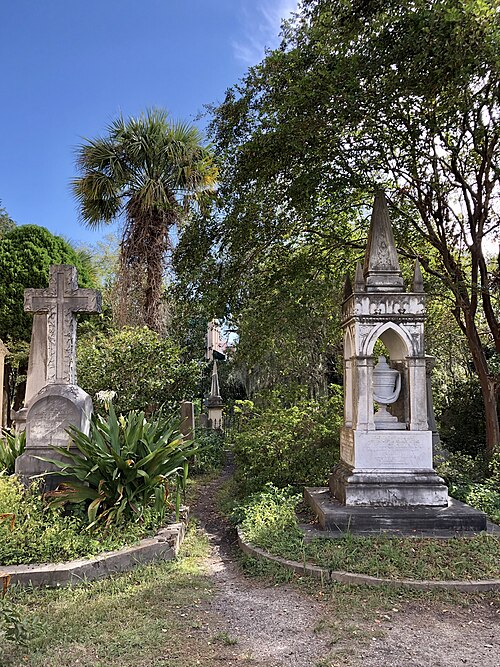
The Gilman Monument in a “natural” graveyard. It is a little neater than that now.
The Haunted Unitarian Church Cemetery – Charleston Terrors
NOTE:
The first-born Gilman daughter, Abby, will marry Francis James Porcher. Right across Archdale Street from the Unitarian Church is the house of Philip Porcher. It has a historical marker. He was an Englishman who was allowed to keep his 34-acre farm after the Revolution because he joined in the Rebellion and was anti-King. Francis was of a different branch of the Porcher family, I think. But I bet Abby and Francis met there, across the street…two kids growing up the same age. But Francis will be a mover and shaker in the Civil War and will become rich after it and built one of the famous houses down at the tip of the peninsula.
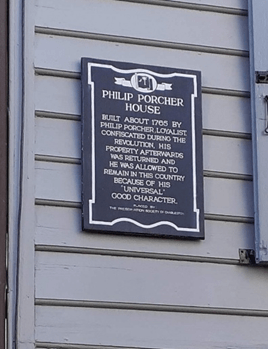
About Francis James Porcher Francis James Porcher (1821 – 1872) – Genealogy
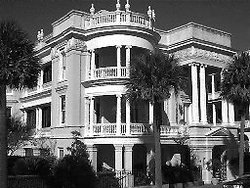
Major in the Army of the Confederate States of America and cotton merchant in Charleston, SC. Delegate to the 1860 Secession Convention FIND A GRAVE RECORD: http://www.myheritage.com/research/collection-
Builder of 29 East Battery, Charleston now known as the Porcher-Simmonds House.
Back to the Graveyard

This is Abby’s tombstone. Both her and Francis are buried near her parents in the Unitarian Graveyard. There is a whole row of Gilman and Porchers and several tombstones in the same style as hers. That is how it usually happens in the western movement of Americans striking out to find a new home. Your kids marry the neighbor’s kids and the world goes around…Cleta
 Finding "My" Charleston...Digging down on the block I live on...to see what I can find.