This edition was published by LEGARE STREET PRESS no date
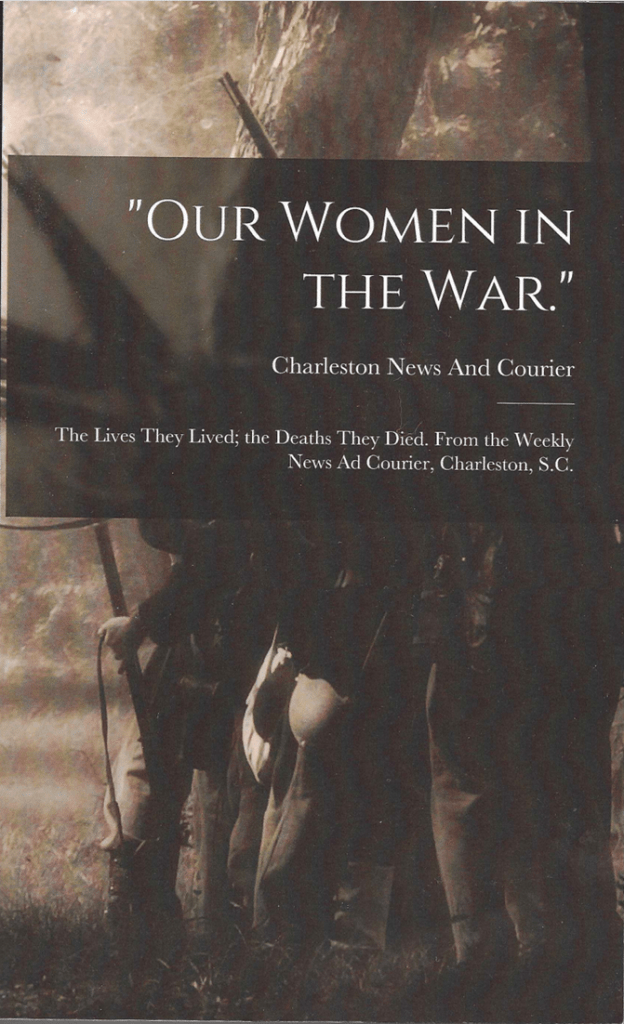
I think I mentioned earlier that I found a treasure of a book on-line called “Our Women in the War.” It is a compilation of women’s stories from across the South. The stories were requested, gathered and published by the Charleston News and Courier in 1885 with the subtitle:
The Lives They Lived: The Deaths They Died. From the Weekly News and Courier, Charleston, SC.
The remembrances were republished in 1988. The book is comprised of direct copies of the original newspaper articles…in very small print…for each woman who submitted. Hard to read but still a treasure. I found two stories centered in Charleston and typed them out for this post on Charleston women.
I have all along worried that eventually I would have to address the Civil War. It came up in my first series on the church under my parking lot at Canterbury House and addressed the local abolitionists Grimke sisters and the Harvard and Princeton men who came here as pastors…and often were abolitionists.
The women in this book, writing years later, recognize the waste of the war…but were not repentant. They saw themselves as patriots of their cause. The first one is a young woman of wealth, and the second one was not…I want them to speak for themselves.
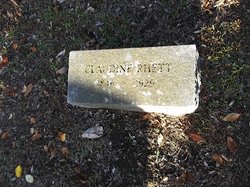
No. 3. Old Confederate Days by Miss Claudine Rhett
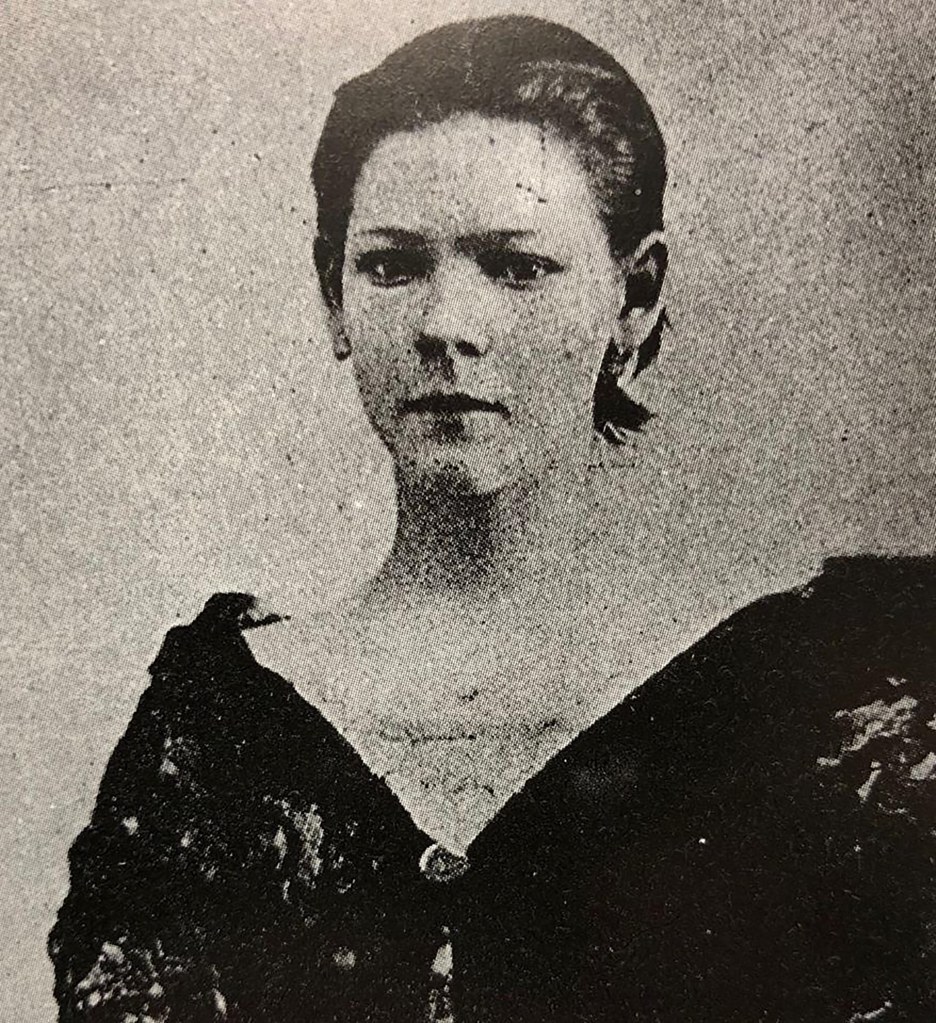
This young woman is not Claudine Rhett but seems about the same age as Claudine when the war began…about 14 years old. The name on the photo is “tillie pierce 1” from Civil War Photos Women
…During the war I endured no remarkable privations and met with no extraordinary adventures. I can relate of my own knowledge nothing very romantic or thrilling. I only lived among those who fought and “made history,” and was an ardent enthusiastic Confederate. Perhaps some of my reminiscences may interest a few of the younger generation, who may like to know how we occupied and amused ourselves in those days, and if it was indeed such a dreadful trial as they may have been taught to believe.
MARTIAL SECENES IN CHARLESTON
I was in Charleston all through the autumn and winter of 1860-61, when so much agitation proceeded secession. The very air seemed to be charged with electricity by the approaching storm of contest. You could not walk more than a few steps down any thoroughfare without meeting young men wearing conspicuously on their breasts blue cockades or strips of plaited palmetto fastened to their button-holes, which attested that they were “minute men,” all ready for duty. Flags fluttered in every direction, and the adjacent islands were converted into camping grounds. Companies drilled and paraded daily on every open square in the city, and bands of music nightly serenaded distinguished men, and made the old houses echo back the strains of “Dixie” and the “Marseillaise.”
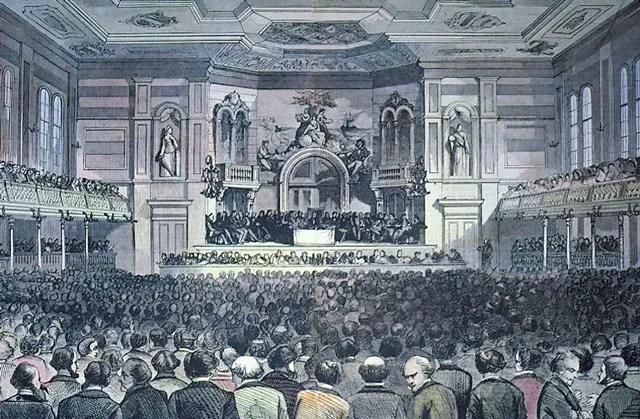
Independence Hall for the Secession meeting from Images
In December South Carolina seceded from the Union, and I shall never forget the evening that the Ordinances of Secession was signed, by the Delegates of each District of the State, at the large Institute Hall on Meeting Street, which was afterwards burnt in the great fire. The scene was one of extraordinary impressiveness and the enthusiasm and excitement spirit-stirring. There was scarcely standing room in the big hall for the eager crowd of witnesses, and the galleries were packed with ladies. As the Districts were called out in turn by Mr. Jamison, the chairman of the convention, and the delegates, one by one went up on the platform and signed the Ordinances, it has become the fashion now to say that none of us wished to secede, and that the State was made to withdraw from the Union by one or two politicians, without the knowledge of the people. This statement is most assuredly an incorrect one, for not a member of the large convention refused his signature to the Ordinance, and no voice was raised that night, save in acclamation. No one living in Charleston, then, can say that he was ignorant of what took place and of the public acquiescence in the deed, unless he was blind and deaf and dumb.
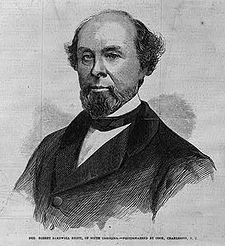
Robert Barnwell Rhett, Claudine’s father who signed the Secession Ordinances. Bluegray Review “O Those were the Days.
THE ATTACK ON FORT SUMTER
Major Anderson surrendered Fort Sumter to our troops on the 12th of April and although I had many relatives and dear friends on duty at Fort Moultrie, the Iron Battery and other posts during that historic engagement, I can’t relate anything that occurred on the occasion having been absent at the time. We all know that it was the first fight of the war; that our success was a great triumph and was hailed with delight all over the country.
HALCYON DAYS
The first battle of Manassas was fought in July, and a shout of joy and triumph went up from the hearts of the people of the South. It is a delightful sensation to feel that you are joyful, in company with six millions of happy hearts, to know that perfect unison exists between you and all those whom you may meet, at least at one point. These were the halcyon days of the Confederacy.
DEPARTURE OF TROOPS FOR THE FIELD
A little later on, that summer, the 1st Regiment South Carolina Volunteers was reorganized…and my youngest brother went with it. He had only recently returned from Europe where he was educated, having acquired during his five year residence in Dresden, Leipzig and Paris much of the cultivation and charm of manner which is derived from early advantages abroad. Before joining his command…he paid us a visit at Aiken, where we were then staying, to bid us good-bye. It was a last farewell, for he fell the succeeding year in one of those terrible battles around Richmond. I lost four cousins in this regiment also; and if Providence had kindly created me a man, instead of a woman, it was the organization which I would have joined…I do not believe there was a woman in the Confederate States , after the hard fighting had begun, who, having to make a choice, would not, any day have preferred a newspaper to her dinner.
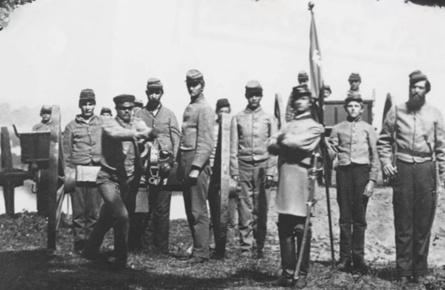
DEPARTURE OF TROOPS FOR THE FIELD Palmetto Battalion Light Artillery | Spared & Shared 23Confederate soldiers of the ‘Palmetto Battery’ in Charleston, South Carolina, 1863. This photograph was taken by George S. Cook, one of the most renowned photographers of the Confederacy. (Photo by Archive Photos/Getty Images)
HOW THE HOURS PASSED AWAY
As time went on we became very expert in devising substitutes for the comforts we had hitherto been accustomed to have, but which now could not be procured, and we vainly tried to replace them by other things…Some of my friends, for instance, substituted parched corn for coffee, and others tried parched ground nuts….I decided to imbibe nothing but pure water…We made vinegar of persimmons, which was very weak and mawkish stuff…Every old lady had some pet receipt of her own invention for some particular need which she would confide in the most earnest manner…
I learned to knit stockings and gloves. Some of the young ladies made hats of palmetto and of corn shucks in this way: The palmetto was shredded into very narrow strips, plaited, sewed together in rows and pressed into shape on a block with a hot iron. ..(Which did not hold up in the rain.)
…Women wrote letters to their absent ones, knitted and read by the light of bright flames, and the weary soldier in the army found their camp fires a solace after the fatigues and discomforts of a long march. Candles were made at home of a poor quality. Sometimes they were composed of tallow and beeswax and sometimes of mutton-suet and wax, and, I have even seen green ones made of myrtle-wax berries, but they were all horrid…
A PICTURE OF PLANTATION LIFE
Having spent the entire winter of 1862… in the country, I can give some account of plantation life at that period. The negroes were perfectly subordinate, and worked as steadily as though no gunboats were at the mouth of the river. Forty hands from one of the neighboring estates went off to the enemy one night, but as a general rule they made no effort to leave, and my father’s remained with us until two years after the war ended, and were perfectly cheerful and respectful. The Yankees tried in every way to inflame the negroes, and to stir up race animosity against us; and judging from their newspapers they seemed to think…that we lived in a constant apprehension. But such was not the case, by any means. We had confidence in the good will which we knew prevailed between the whites and the blacks, and only a few persons in the Confederacy every dreaded or anticipated any such catastrophe (as a rebellion of the slaves). During the course of that winter another lady, myself, and several little children were often for weeks at a time the only white persons on the plantation, or within three or four miles of our home; yet we felt so little uneasiness that I never locked my bedroom door at night, and the back door of the house was always left unlatched, so that the servants might come in early in the morning to make up the fires without disturbing anyone. There were hundreds of negroes on our estate and on those adjoining, but none of us every thought of being afraid of them.
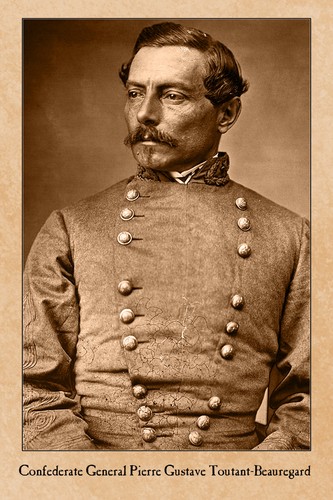
The ladies of the Confederate States did not spend their woke time in devising ways and ways and means, however. Gen. G.T. Beauregard was again in command here during the year of 1863, and as he was a great favorite in Charleston, he received many attentions and was handsomely entertained in spite of the “hard times.” Balls and parties of all kinds were given, and social intercourse was made particularly pleasant by large numbers of strangers who were stationed in the city or vicinity. A number of very agreeable Creole gentlemen were on Gen. Beauregard’s staff and in Legardeur’s Battery on James Island, so that French at that time became as much the language of society as English, for most of our ladies of our community spoke to that officer, his staff and a crowd of spectators from the city. language, more or less, well.
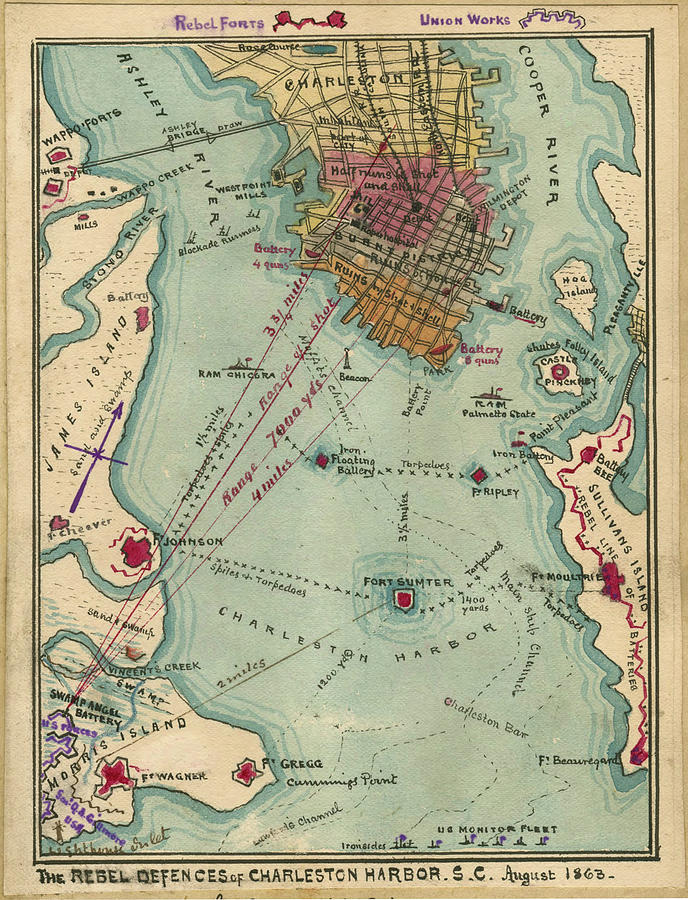
Expeditions to Fort Sumter were very popular, and any review of the garrison (First Regiment South Carolina Regular Artillery) by either Gen. Beauregard or Gen. Ripley was sure to be attended by many of their lady friends. A steamboat would carry down the general officer, his staff and a crowd of spectators from the city. When the review was over the fine regimental band would play, and while those who liked dancing waltzed in the casements, others who preferred “al fresco” pleasures walked around the parapet or chatted with their friends upon the big guns. Then a collation would be served in the mess-hall, and afterwards the pleasure seekers would bid adieu to the old fort and the handsome regiment and return gayly to their homes by the light of the moon. The apparent strength of Fort Sumter and the magnificent drill and discipline of the garrison…gave us great confidence in their powers of resistance in case of attack upon Charleston by sea…but alas! Those high and broad ramparts were destined to be knocked to pieces in a few weeks’ time over the heads of their brave defenders.
Steamboats, Ironclads, and one submarine on view at Patriot’s point.
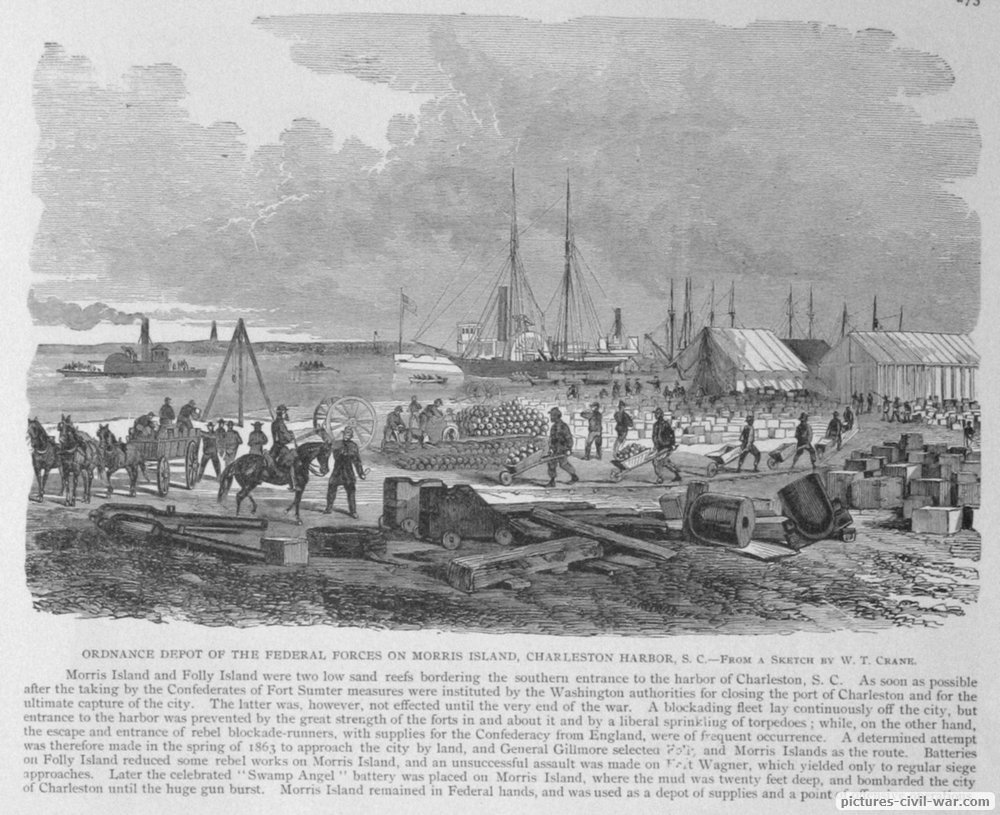
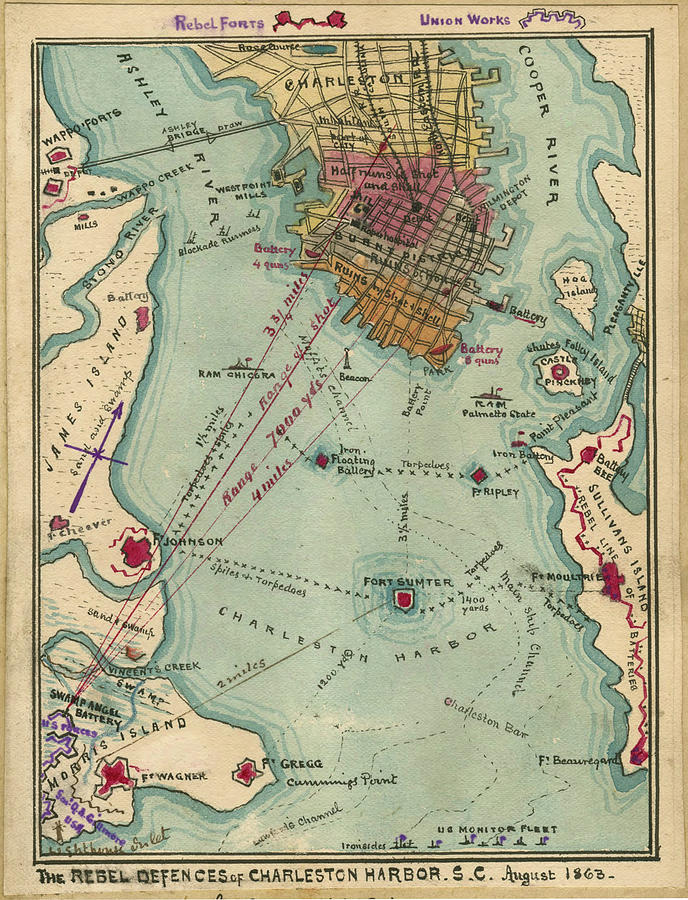
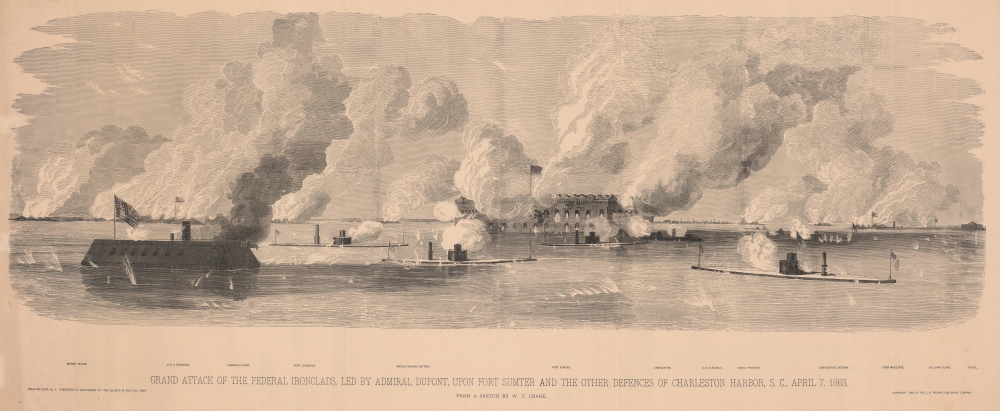
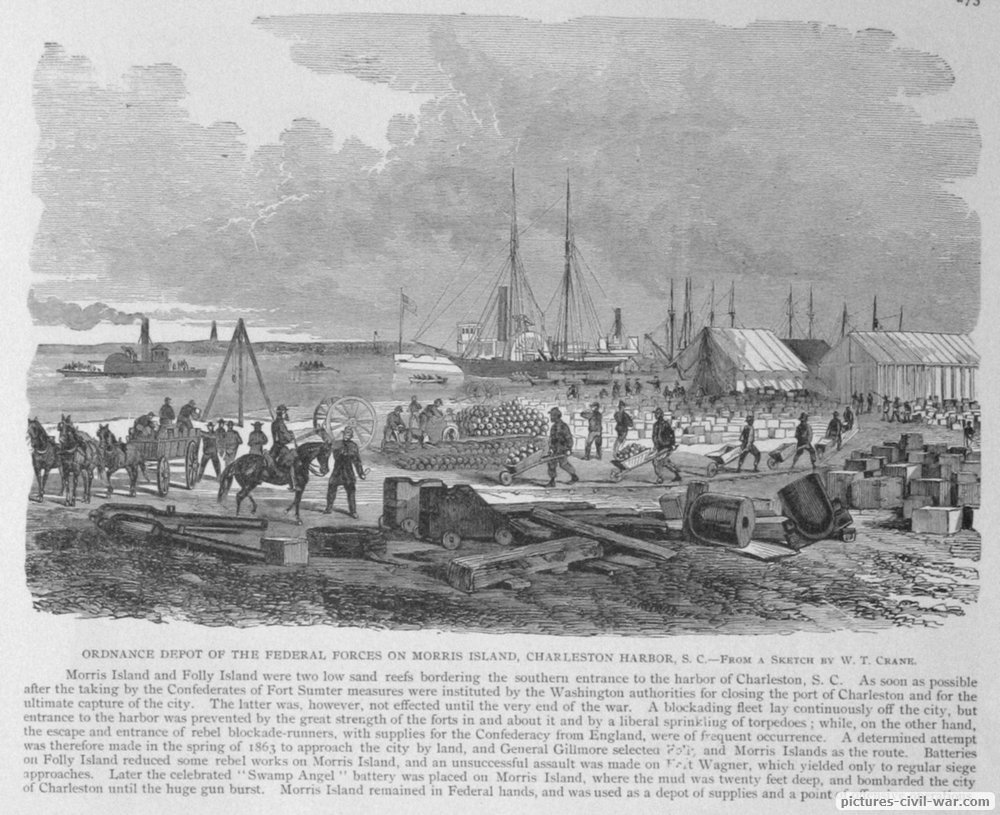
After this attack we were left in quiet until the 10th July, when the fighting for Charleston, which was to continue almost to the close of the war… began again on Morris Island. Our anxiety now grew terrible, as Morris Island was fought for and then evacuated, and Fort Sumter was torn to pieces by the cross-fire which was brought to bear on her from the immense guns the enemy mounted on Morris Island and those of the fleet. …
AT THE CITY ON THE CONGAREE
We were sent off to Columbia at this period, being non-combatants. On Sunday no newspapers were published, and dreadful; reports circulated wildly about the streets of our capital…until we learnt to be too incredulous to believe anything we heard outside of the churches.
There were votaries devoted to three occupations in Columbia at this time: The “Sewing Society for the Soldiers” which met during the morning hours; “Prayer Meetings every afternoon at the Presbyterian Church,” and “Surprise Parties” at night. Oh! The tedium of these last mentioned entertainments. I yawn at the mere recollection of them! They were conducted in this way: About fifty girls would meet at some friend’s house, where they would be furnished with a piano and a room, but no supper. Ten or twelve cadets from the Arsenal belonging to the youngest class of the State Military Institute would join them…if it was a favorable occasion…some young man on furlough. If one of the latter…happened to be an acquaintance and talked to you more than five minutes the eyes of the forty-nine girls became so fixed upon you that your only desire could be to get rid of him as soon as possible…
Blockade-running was a subject which interested us deeply, for as the war progressed all the muskets and equipments which were furnished to our troops came to us in this way. One-third of every cargo brought in by John Fraser & Co. belonged to the Confederate Government, which had no ships of its own…The blockade of the port of Charleston became stricter and closer from year to year, until at last it was almost impossible for a vessel to slip through the hostile fleet without being captured. Ships could always run out of the harbor much more easily than they could enter, because they could choose a dark or foggy night and the time of tide which would help them most. Coming in they had to trust to luck very much and just make a rush across the dangerous bar. When the captains kept cool and were wary, they managed to elude pursuit, and I have heard that Capt. Lockwood, who came and went continually, never lost a boat, but some of them got so excited when they were chased that they would keep up their speed, even after they were perfectly safe and protected by the guns of our forts, and more than one blockage-runner was wrecked upon the Sullivan Island breakwater or shoals within the harbor after escaping all the perils of the sea.
Late one evening I was in a row boat with some friends, and a blockade steamer passed close by us, on her way to Nassau. She looked like the veritable phantom-ship of tradition as she glided past. No ghost could have moved more silently, or looked more mysterious; and we all felt a sort of mystical enchantment as we watched her rapid, stealthy progress. She was painted a smokey gray color, and could scarcely be distinguished in the light mist which enveloped her. Not a lamp gleamed aboard; no sound could be heard except very faint echoes of her revolving wheels, and no smoke seemed to be thrown out by her engines. Everything to ensure a successful trip had been carefully studied and prearranged. She passed like a spirit through the midst of the blockading squadron, and twenty-four hours later dropped anchor in the sparkling tropical waters of her Nassau haven. Three requirements were needful in this dangerous traffic to ensure success; these were a bold captain, a swift steamer, and a noiseless crew.
THE SHADOW OVER THE SOUTH
The years rolled by and the war dragged its weary course to a conclusion, while the dark gloom of hopeless effort overshadowed us more and more. Our ports were closed one after another, the people at home lost heart, and the armies, which from the first had been half clothed and fed, were at length in rags and the men and their horses hardly had enough provisions given them to keep life in their bodies…
Meanwhile, Sherman having no one to oppose him marched his army down to Savannah, and thence through our devoted State, carrying the torch to subdue the women and children whom they met in their manly course of devastation The track of this noble army could be followed at a distance of twenty miles with the naked eye by the columns of smoke which ascended from every homestead, village, and town it passed near….
At last, we reached Eufala (Alabama where they fled when the Union entered Charleston)…
It was there that we heard of Lee’s surrender. One evening the Episcopal clergyman who was a kind friend, came in and said, with agitation in his manner: “I have very bad news to tell; Gen. Lee has surrendered his army.” He then drew from his pocket a telegraphic dispatch, which had been sent to the mayor of the town and read the official announcement in a broken voice. The hot tear-drops were our only reply, and we thought of the lives that had been given in vain, and the sorrows that were to overwhelm our unhappy country. “God’s will be done,” said our good friend solemnly.
No. 9—Charleston During the Siege By Mrs. Pauline Dufert, of Charleston
The surly drums beat terrible afar With all the dreadful music of the war.” Breems
Now that years have passed since the sullen clouds of fratricidal war have rolled back and the azure sky of peace again droops like a liquid canopy over our Southern, sunny land, it well becomes the patriotic women of the South to embalm in song and story the heroism of their sex during that terrible struggle, as well as to narrate the appalling incidents which were of almost daily occurrence during the latter part of the struggle for Southern rights.
Our family, like many others in Charleston, were compelled to fly from the city just before the memorable battle of Secessionville, which took place June 13, 1863, and take refuge in the capital of the State. The family consisted of my mother, two married sisters and myself. My husband, having been previously assigned to duty in Charleston, could not accompany us to Columbia, and, not being able to reconcile myself to the separation, with his consent I returned to the city for a short visit with my children, but never left it afterwards…
Our home in Charleston being situated in the extreme northern section of the city, and consequently out of reach of the shells, it became a refuge for many. My parlor was given up to an old gentleman afflicted with paralysis, and to his wife. At the same time a lady and her daughter were occupying my brother’s room. He, like all other patriotic Southern men was in the service of his country. Those occupying apartments in my house had been driven from their homes by the shells, and were remaining with me until they could find more comfortable shelter. They remained several months, and shortly after they left an old lady with her niece and an afflicted son came to beg permission to remain in my home for the night. She did not ask for a bed, but a shell had struck the house where she resided, and the danger was too great to return….
These facts are mentioned to show the condition of the people in the central portion of the city. Whenever more powerful ordnance was brought to bear against the city, the shells would be thrown higher up and in this way hundreds of persons were continually compelled to move from one place to another and throw themselves upon the mercy of those whose homes were out of range. The entire lower portion of the city was deserted, save by a few who were too poor to find shelter elsewhere, or who, like the prowler Themardler among the dead at Waterloo, remained to pillage the unoccupied houses.
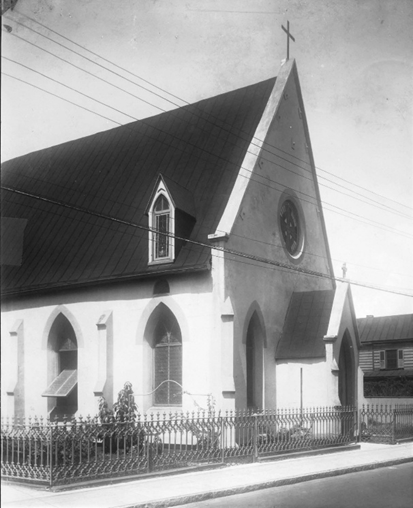
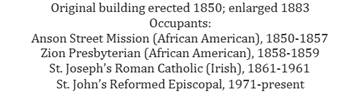
The original St. Joseph Church was known as the “Church of the Irish.” When it was dedicated, it became the fourth Catholic Church in the city of Charleston.
The original building was built in 1852 and was used by the Zion Presbyterian Congregation. The building was bought at auction by the Diocese of Charleston. The church was dedicated by Bishop Patrick N. Lynch on May 5, 1861. The Reverend Patrick Ryan, an assistant at St. Mary’s Church, is given credit for urging the establishment of the church, realizing the need for a church for the poor Irish immigrants of the “borough” in 1860. The Reverend Leon Fillion was the first rector.
One Sunday while attending Divine service at St. Joseph’s Church—I was then organist, and that day we had a number of Louisianians assisting in the choir—a scene occurred that almost beggars’ description. During the sermon, which was delivered by a chaplain on furlough from his regiment, the alarming whiz of shells and the bursting of the missiles in close proximity struck terror in our hearts, but we remained at our posts. Suddenly there came a tremendous crash, shaking of the church to its centre, and a young lady of the choir, frenzied through fright, shrieked out “A shell! A shell! A great commotion and almost a panic followed, but the brave chaplain, as calm and composed as a priest before the altar…requested all to keep quiet for the danger was over. The calm, however, did not last long, for within a few minutes time another shell struck the Elliott Mansion, immediately in the rear of the church, and the stampede became general. With the assistance of my husband, I gathered together my music, and we hurriedly left with the retreating congregation…A few brave ones remained with the pastor until the services were concluded. Ten days after this a shell struck the east corner of the church tearing the organ to pieces. It was only after this that the pastor, the good and brave Father Fillion, could be persuaded to leave his home adjoining the church…
ANOTHER SCARE AT CHURCH
The city was now deserted from the Battery to Calhoun street. Grass and moss were growing upon the crumbling walls, and all that was required to intensify the horror of the desolation was the cry of a voracious hyena. Save the occasional whiz and crash of a shell, there was nothing to break the monotony of the silence drear, and the mute angel kept sentinel over all.
St. Mary’s Catholic Church on Hasel St.
The husband of the lady who had so kindly loaned us the melodeon died, and was to be buried in St. Mary’s church-yard in Hasel street, the very centre of “Shell district.” I was requested by the bereaved widow to play the Requiem at the church, and though anxious to oblige her, I hesitated when I thought of the danger. She pleaded and assured me no harm would come, for God, who was every good, would hear her prayers for our safety. Yielding to her entreaties I started, in company with my husband and my little boy of seven summers, for the church. While waiting for the doors to be opened a shell fell in front of the Charleston Hotel, but did not explode. This was somewhat of a relief, for it was a rare thing to have two shells strike in the same place on the same day. It was apparent that the artillerymen shifted their guns a little every time they fired. The funeral services were concluded without any further annoyance, but just as my husband was closing the organ another whiz was heard, then a flash was seen, followed by a tremendous explosion. A shell had burst in the rear of the graveyard. We were glad to hurry away, and a week later St. Mary’s organ was smashed by a shell.
A WALK IN THE “SHELL DISTRICT”
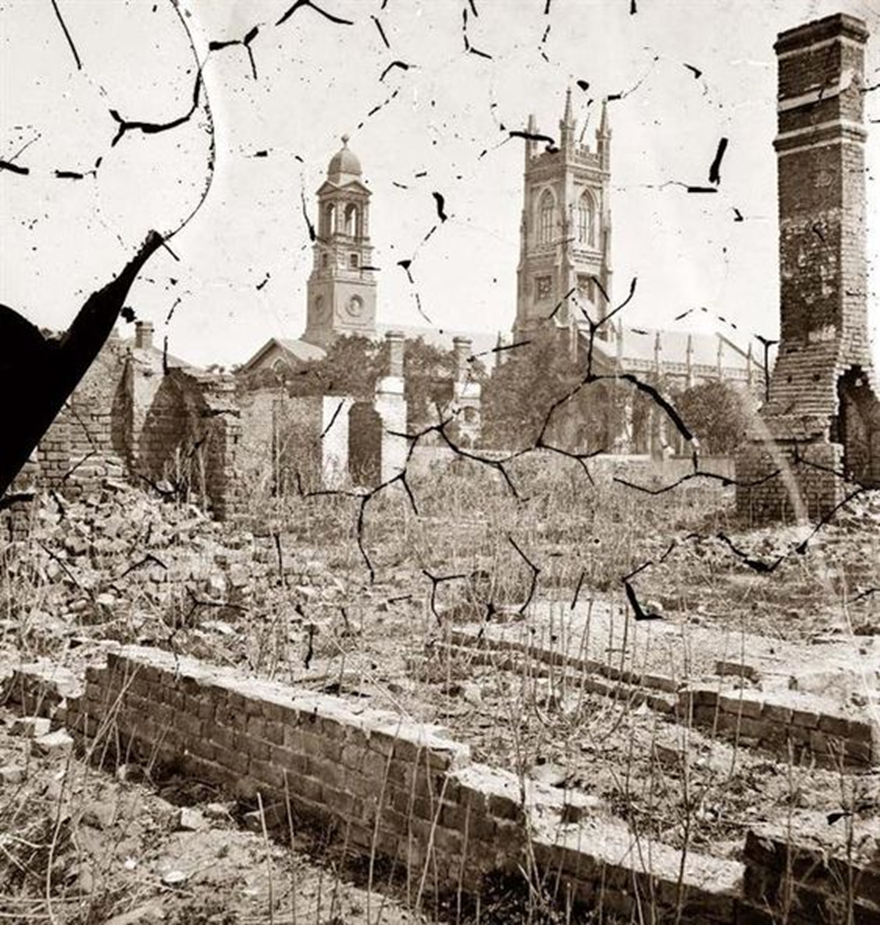
Archdale Street across and down from the two church towers: St. Joseph Episcopal and the Unitarian Universalist just on the border of the shell district.
Occasionally the enemy would grant us a period of rest, and sometimes for days no shells would be thrown into the city. It was during one of these intervals that I, in company with a lady, my two little boys and their nurse, undertook to make a tour of the doomed portion of the city. It would be impossible to fully describe the harrowing feelings which came over us as we viewed the destruction caused by the improved ordinance of civilized warfare. Large stores, with brick, stone and iron fronts, were torn and shattered into shapeless wrecks. Window panes of the greatest thickness were slivered to millions of pieces, while bricks and broken plaster were scattered in promiscuous confusion. The most active business portions of the city were the most battered; grass and rank weeds were growing along the streets, while in the cellars, rabbits and vermin found shelter…
My mother owned the large bakery on East Bay below Broad street. And as that section was in a better condition that other portions of “Shell district,” we turned our steps in that direction. On reaching the place we found the bakers at work, and learned that the baking was done in the day time, as the danger was less—the shelling being heavier at night. Sixteen shells had already struck the building, but no one had been hurt and the oven was still fit for use. One of the shells, like Truth, lies hidden in the bottom of the well. The master of the establishment made us quite welcome, and as a token of his appreciation presented us with a hot loaf of bread, all he had to offer. On our return we sat down on the steps of the Bank, at the corner of East Bay and Broad streets, and ate our dry bread with a gusto more easily imagined than described. How strange! How unlike those ante-bellum times, when our care was to guard against a surfeit of foreign and domestic luxuries. I could not refrain from remarking to my companion: “When in after years we tell our children that we sat on these stone steps eating dry bread, for the want of something better, they will hardly believe us.
A DAY NEVER TO BE FORGOTTEN
On the night previous to the evacuation of the city by the Confederate forces, the fiery glare of the gunboat, which was being destroyed by fire, at the head of Columbus street (Hampstead) and that of the burning bridge of the Savannah Railroad, reddened the skies and lit up the whole of the upper portion of the city. The weird, restless light, together with the pervading silence, struck even the bravest hearts with awe. For some time previous to this memorable night our homes were guarded only by women. My husband was compelled to leave the city, and my only brother was in the army elsewhere…Only a short time prior to the evacuation (my sister) returned to my home and was, on the night above mentioned, sick in bed with a dying infant of only five days. My mother was suffering agony with an affliction of the eyes, which finally terminated in total blindness…
At 7 o’clock in the morning the last of our brave, tired troops, hitherto stationed at James Island, were leaving the city, and as they passed our home, with firm and gallant tread, we bid them farewell, and turned away to hide the tears which gushed from the fountains of our heart.
THE CITY SHAKEN BY AN EXPLOSION
As our provisions were exhausted and we were informed that the commissary stores were being given for Confederate money, I collected what amount we had in the house and with my servant started for the quartermaster’s department at the head of Columbus street. Before reaching there a tremendous explosion which shook the city to its very foundation brought us to a halt. Crowds of frightened women and children, white and black, came running towards us, some of them saying “Don’t go there,” “you’ll be blown to pieces,”, etc.
Scarcely knowing what to do or how to act, we took our stand in front of the railroad workshops on Meeting street, and others joined us. We had not been there long before some one hurrying by said; “Ladies, how can you stand here when those workshops are to be blown up?” One of the ladies who had already been frightened on hearing this ran up the street in wild alarm and we were no less terrified. I reached home and for a while was almost frantic. All those around me were panic stricken and helpless, and the good Father F____ was in the next house in a dying condition.
I appealed to Heaven for aid and at once commenced preparations to have my sick sister removed. There was no time to be lost, for we were very near the railroad shops, and should they be blown up we would certainly be destroyed….mostly unreadable paragraph…and hearing that Father Fillion had just died, I inquired the cause of her (Mother Superior of…Sisters of Our Lady of Mercy) excitement. She quickly answered, “I am going for a cart or something to remove the poor sufferer, for he cannot be left there to be blown up!
…After a while the consoling information came to us that the order to blow up the buildings had been countermanded…Oh, merciful Heavens! What a relief!
A SCENE OF WILD CONFUSION
But our trials were not yet ended, for there came another terrible explosion—louder than any yet—the smoke of which darkened the sun as its hideous folds curled skyward. It was the North-eastern Railroad depot that had been blown up, and with a number of persons who had gathered there in search of provisions. Some were killed outright and their mangled bodies and limbs were scattered and buried under the burning ruins. Many were wounded, burnt and disfigured for life. The flames spread rapidly to the adjoining houses an soon a fearful conflagration was in progress. Confusion became worse confounded every moment and the wings of the dark angel seemed to have been outspread over every dwelling. The Rev. Dr. M______ had been called to the wounded and we were waiting on him to baptize our little babe who was breathing life fast away. Finally he came in great haste, and seizing a cup near by filled it with water and performed the ceremony. He left immediately to attend Father Fillion next door and the child died that night.
The city was now a scene of wild disorder, and we were to be still more humiliated—it was to be given up to Federal authority. Quiet was at last restored. We had surrendered! Old Charleston, hitherto invincible by land or naval forces, while her gallant sons could remain to defend her, was given up; but it was a ruined people and a shattered city, and the sight softened and touched the heart of the enemy…
THE FAMILY DEATH TOLL
…My brother-in-law, John L.D., while in service in Virginia, was stricken with fever, and while in hospital a shell came very near to striking his bed, but fortunately did not explode. The hospital was pronounced unsafe, and my brother-in-law, being no longer fit for duty, was sent home. Having no means of transportation, he walked his way home, and when arrived his condition was such from exposure that, notwithstanding the most careful nursing, he died in a few months. My nephew, Virgil D., a young lieutenant of only 19 years, and beloved by his regimental commander…who had nicknamed him the “Virgin of the regiment,” was wounded in a fight along the Weldon road in August 1864 and was taken prisoner at Fort Monroe. His sufferings were so great that he was commanded against his desire to return home on parole. On his return home, his youngest brother took sick with the smallpox of which he died, and the young noble young officer, whose system had already been exhausted from his wound, contracted the disease and was buried five days after. My cousin, John M., a bright boy and the hope and comfort of his widowed mother, entered the service at the age of sixteen as a corporal in the Charleston Riflemen. He was taken prisoner and confined in Elmira and from the hardships of prison life soon became prostrated. Like a caged bird, he pined for liberty, for he was anxious to serve his country in the field…As far as this world is concerned, the darkest hour of his life was just after dawn, for when about to be exchanged with prisoners at Point Lookout his strength was so much exhausted that he was sinking rapidly. A cup of tea was handed him by a companion who also was to be exchanged; he drank it with great pleasure, the last spark of life was waiting upon the water, and in a few minutes afterwards the youthful soldier breathed his last, and now sleeps in an unknown grave on the Federal side.
CLOSING SCENE
After the close of the war, in the beautiful month of May, when the troops were returning home, I awaited anxiously to welcome two survivors, an only brother, F.D., and another cousin, L.B. They had both served the Confederacy to the end. What anxiety, what eagerness, to behold the brave fellows—our dear ones—who had suffered and endured so much! The glad tidings at last reached me that my brother was coming on horseback and the gates were opened wide as our hearts to receive him. But alas! What a change! That grand colossal frame, which at one time seemed constituted to bear the weight of a hundred years, was bent and worn, from hardships and exposure of camp life. His aged mother, who had become blind during his absence, saw him again before her “mind’s eye” only like the sturdy young oak that he was when he first buckled on his armor and departed with her blessing on his head. To me, who was blessed with sight to look on, the meeting was sad and touching in the extreme. After such an embrace as only a mother and son can give after years of separation, he exclaimed:
“My poor, dear mother, you cannot see me!”
“Never mind, my son,” she replies. “I can feel you, and have you with me in the future,” But, alas! This hope and comfort was shortly to be crushed. On the 6th of September of the same year, not withstanding the most careful nursing, he died and was added to the silent majority of our heroes.
The young cousin, too, L.B., of the Washington Light Infantry, whose system was shattered before he reached home, was kindly, lovingly nursed. But he drooped and drooped day by day. He died in August of the same year, aged twenty years. His name is inscribed on the monument at Magnolia Cemetery.
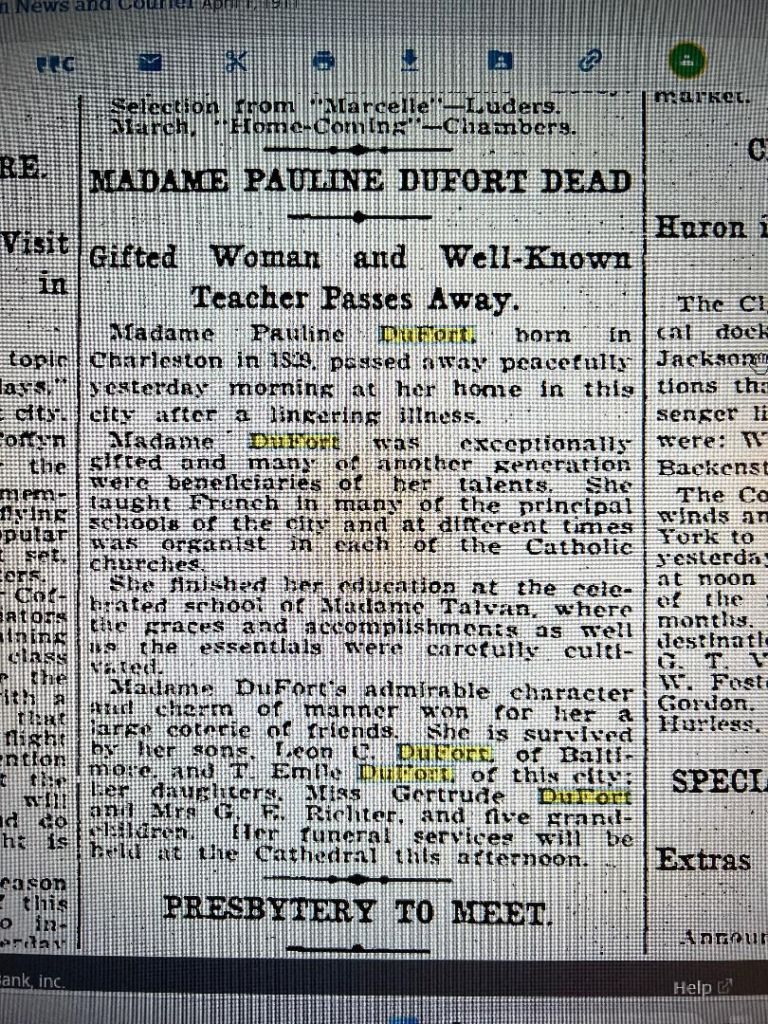
A little change in the spelling of Pauline’s last name made a big difference. Dufert to DuFort…makes her a “Madame” and French. A good lesson for researcher. I googles her as Dufert and she came up DuFort but clearly the same women. Also, a note: Pauline never mentions her husband’s name or what became of him. Neither does the newspaper article and Find a Grave…parents and children but no husband…another mystery.
What can be learned from their stories? I had a 90-year-old friend five years ago who swore that the Civil War was not fought over slavery, but the white people of the South were patriots in the war for state’s rights. And most of the accounts I have read written by slave owners here and in St. Charles, MO, claimed that their slaves were happy and treated well. As, some were. But it is now well documented that not all were by any stretch of the imagination. And Charleston was a focal point of the system run amuck. The slave trade grew beyond simple survival. There were more slaves than owners and the owners grew very rich and powerful because of their slaves. If we could go back in time, could we now come up with a better way for settlers in a wilderness with no access to help build a city that would prosper and grow and for women to have a bit of freedom? Sad to say, I don’t know…but surely somewhere someone is working on it…Cleta Flynn
 Finding "My" Charleston...Digging down on the block I live on...to see what I can find.