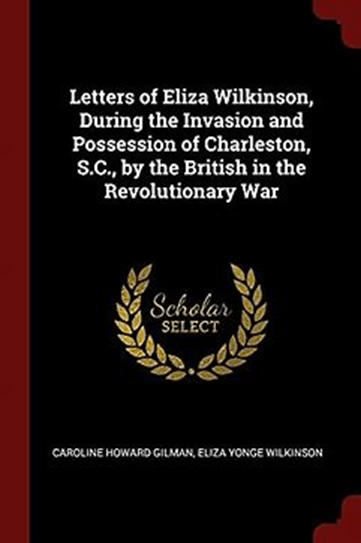
I also found this book when I first started researching Charleston and put it on my shelf. It took me four years but once I seriously went looking for a few women to write about, I read it through and fell in love with Eliza. She was not strictly in my neighborhood…but in the next post, the woman who published Eliza’s letter, was…close enough.
To set the stage: Affra Harleston Coming, an original settler, died in 1698 and Eliza’s letters actually begin in 1779…81 years later…the town was still a fortress.
While Eliza is very capable of speaking for herself, I wanted to lay some groundwork for her situation. Taking the liberty of using A Short History of Charleston by Robert Rosen (University of South Carolina Press1982, 1992, that I quoted extensively in the Affra post…my favorite book on the history of Charleston…here is a very brief encapsulation at the expense of some great stories of what led up the American Revolution as it happened in Charleston, Carolina Colony…
Setting the Stage…
Ever since the days of the Proprietors who established Charles Towne as a money-making venture, there had been a split among the residents over England and the King. The wealthy plantation owners and merchants were English and sided with England. The “mechanics”, the working class, artisans and laborers, alike, sided with the growing unrest against being ruled by a King. When the Tea Party began in Boston…no taxation without representation…Charles Towne sent rice and help.
“Efforts at reconciliation with the English government having failed, the American colonies declared their independence. Independence was adopted in principle on July 2, 1776. On the very day the committee assigned to draft the Declaration of Independence reported to Congress, the first attempt to crush the revolt in the South was made in Charleston harbor.”
The first British attempt to take Charleston which was a good choice for them…the town was situated on a wide-open peninsula with only its walls to protect it. They came by sea. Charles Town quickly built a fort on Sullivan’s Island. Fort Moultrie won the first battle of the Revolution. It was downhill from there…half the town still wanted to have their King and the other half did not.
The siege of Charlestown began on April 13 (1780) and lasted one month…The women were sent out of the city or sent to the cellars. Bombs, “red-hot balls” and “carcasses” (an iron-frame bomb) descended on the city, bringing fires and death. Finally, the people of Charleston asked to surrender.
The terms of surrender were that regular Continental troops would become prisoners and that soldiers of the militia and townspeople could return home on parole if they promised not to take up arms against the King again. They did not, however, have to agree to take up arms for the King. “Sir,” one British officer said to Moultrie, “you have made a gallant defense. But you had a great many rascals among you…who came out at night and gave us information of what was passing in town.” The Tories of Charlestown were still active.
Charlestown was occupied for the remainder of the Revolutionary War. The Tories had their day. Two hundred citizens presented an address to the British conquerors declaring their loyalty. Some entertained the British officers and offered their assistance. Most Charlestonians, however, remained loyal to the Revolution…A Short History of Charleston
This is the backdrop for Eliza’s letters written after the British broke the siege and invaded Charleston and the plantations surrounding the town.
Now a brief history of Eliza…
Wilkinson, Eliza Yonge, February 7, 1757– ca. 1810s…Born on February 7, 1757, on Yonge’s Island, St. Paul’s Parish, Eliza Wilkerson was the third child of Francis Yonge, Sr., and his first wife, Sarah Clifford. While still in her teens (17 years old), ca. 1774, she married Joseph Wilkinson, a descendent of another prominent planter family in the region. He died within the year. Their son, born in 1775, died soon after birth. Widowed and without resources, Eliza returned to Yonge’s Island, where her father put her in charge of one of his plantations, ensuring her independence and wealth….
The letters reveal a young woman (22 years old) who is self-assured, somewhat feisty, obviously charming and attractive, and possessed of a ready wit and engaging personality. She is high-spirited and on the way to becoming an ardent rebel. In fact, her writings are historically significant not only because of the day-to-day descriptions they provide but also because they show how subjects loyal to the British crown could turn into American patriots. Wilkinson, Eliza Yonge | South Carolina Encyclopedia
Without further ado…Eliza, herself…
Letter I.
To Miss M…P…, Yonge’s Island, 1782
As I mean never to forget the loving-kindness and tender mercies of the renowned Britons while among us, in this ever-memorable year 1779, I shall transmit you a brief account of the polite behavior to my Father and family, where you will find me sufficiently punished for being something of an unbeliever heretofore. You know we had always heard most terrible accounts of the action of the British troops at the northward; but, (fool that I was,) I thought they must be exaggerated, for I could not believe that a nation so famed for humanity, and many other virtues, should, in so short a time, divest themselves of even the least trace of what they once were
Surely, said I, they can’t, in so short a time, have commenced savages, and lost those virtues which have distinguished them from other nations. Yet, sometimes, when I heard fresh accounts of their cruelty to our Northern brethren when in their power, I could not repress my indignation against the barbarous, hard-hearted Britons, (how changed their character) and believed, or almost believed, what I had heard of them. I say almost, for I was so infatuated with what I had formerly heard and read of Englishmen, that I thought humanity, and every manly sentiment, were their inherent qualities;–though I cannot but say that, much as I had admired the former lustre of the British character, my soul shrunk from the thought of having any communication with a people who had left their homes with a direct intention to imbrue their hands in the blood of my beloved countrymen, or deprive them of their birthright, Liberty, and property. The thought alarmed me, shocked me. I began to look on the Britons in earnest as enemies.
Thousands would I have given to have been in any part of the globe where I might not see them, or to have been secure from the impending evils, which were ready to burst over our heads.
I was in Charlestown when we heard that a large party of them had landed somewhere near Beaufort. I saw several detachments of our Southern troops leave town to oppose the invaders of their country. They marched with the greatest alacrity imaginable, not regarding the weather, though the rain poured down incessantly upon them. I cannot describe my feelings upon this sight, and then every good wish attended them. However, it was not long before our little band of patriots returned to their homes in triumph, excepting a few, who had sealed the cause with their blood. Peace to their ashes, and everlasting happiness to their immortal part.
“Well have they perished—for in fight they fell.” I think old Priam says this of his sons, who fell at the siege of Troy. But who can forbear the tear of sympathy for the distressed families, who are left behind to mourn the fall of those they highly valued, and from whom they derived their support? Pitiable reflection! “How seldom do the rich feel the distresses of the poor, and in the midst of conquest and acclamation, who regardeth the tears and afflictions of those who have lost their friends in the public”?
Now, the time drew near when this State was to have her day of suffering in sympathy with her sister States. O, how I dreaded the approaching enemy! I had thoughts (with my other friends,) to go higher up the country to avoid them; but as my Father, with many others of my relations, had not conveniences ready to carry off their effects with them, and as the enemy approached rapidly, they agreed to stay. It was a melancholy sight to see such crowds of helpless distressed whom, weeping for husbands, brothers, or other near relations and friends, who were they knew not where, whether dead or alive. When the enemy were at Ashepoo, or somewhere theareabouts, my sister and sister-in-law were then at my Father’s, when one Sunday morning a negro wench, who had been out visiting, came running home in a violet hurry, informing us that the party of British horse were then at Mr. W’s, not above five or six miles from us.
A boy on the road had informed our servant of the approach of the enemy. This created such confusion and distress among us all as I cannot describe. A boat was immediately pushed off. My sister Yonge, my sister Smilie, and myself, were desirous of putting the evil day afar off; so we went over the river to Mr. Smilie’s. Father and Mother ventured to stay at home. Melancholy were the adieus on both sides. We had got but a small distance from the house when we met another lady, who, upon receiving the like information, had walked about two miles, (if not more,) to Father’s. She joined us and away we went, often looking back, with watery eyes, to our Father’s dwelling, thinking, at the same time, that in all probability, even while we were looking, he might be suffering all the insults and cruelties that a remorseless gang of barbarians could inflict. These thoughts drew sighs and tears from us; however, we made the best of it, and endeavored to console one another the best we could; but poor was that consolation, you may think.
We had but just got over, when a scene presented itself to us, enough to move the hardest heart in the British army could they have seen it. This was a large boat-load of women and children on their way to Charlestown, as that place promised more safety than any other. They called at Mr. Smilie’s, and staid a day or two. I pitied them all greatly, (though we were much in the same situation) one lady especially, who had seven children, and one of them but a fortnight old; thus, in her weakly situation, to venture her life and that of her babe, rather than fall into the hands of an enemy, whose steps have been marked with cruelty and oppression. Surely, if the British knew the misery they occasion, they would abate their rigor, and blush to think that the name of Englishman, (once so famous among the Fair) should now produce terror and dismay in every female breast. I’ll now lay by my pen—Farewell.
I will proceed by and bye with my narrative, for the various scenes I’ve been witness to are so much in my head that I shall not want subjects to employ my pen for some time.
Once more adieu
Eliz. W.
Letter II
I resume the pen—but don’t smile at my historical manner of relating matters of fact. I choose to be methodical, my dear, and begin with my fears and apprehensions, and you shall have them all verified in due time and place.
We staid at Wadmalaw for some time. The enemy were all around my Father’s, but had not as yet been so complaisant as to visit him. The whole country was open to them. Nothing but women, a few aged gentlemen, and (shame to tell) some skulking varlets, inhabited it…
The poor women were in the greatest distress imaginable. There was no hearing from Charlestown, where all our relations were ready to defend the town in case of an attack, and waiting for General Lincoln. Him, too, we could hear nothing about, unless from disaffected people and negroes, and they were always the most disheartening account that we did hear. Once we heard that the enemy had surrounded the town; that they were at Wando, James’s Island…however, it seemed that they had cut off all means of provisions getting to town, and that our troops there were in a starving condition…
Many days were we [all the ladies] in this cruel suspense, lamenting the situation we were in, and the report concerning our brethren in Charleston…When I found how affairs stood in Wadmalaw, I took a melancholy leave of my sister, Mrs. Smilie, and returned to my Father’s. But still I could hear nothing of our long-looked for General. It was moving—in the highest degree distressing, to hear the cry re-echoed from every trembling mouth. “Where is Lincoln?” but rather, said I, where’s the Lord God of Israel? Will he indeed deliver us into the hands of these Philistines? No…for, though the whole country was open to the enemy, nothing but women and children left unprotected at home; husbands, fathers, brothers, friends and countrymen far away…
At last my brothers, with the Willtown hunters, arrived from Charlestown. Judge of our joy, augmented, too, by their assuring us that they had heard from Gen. Lincoln; that he was hurrying to our assistance, and would soon be with us! …Hope seems implanted in us. It is the foundation of happiness. The great Creator, knowing our weak, desponding natures, has endowed us with it to soothe, soften, and heal the wounds of keen distress and anguish and make us bear with fortitude the many misfortunes which attend humanity….
Farewell! My dear Mary. I am in a moralizing humor, so I will lay down my pen. And induce reflection for awhile. I am very busy now, so that my hands and thoughts will both be employed in work and contemplation. You will laugh, and say I am a contemplative mortal. Yes, by fits and starts; a philosopher too, in my way! …Once more, adieu—Heaven bless you. Eliza W.
Letter III
You see I am in a perfect rhapsody this morning!…
But I must continue my narrative…
As the enemy were moving over to the islands about us, Mr. Smilie quitted Wadmalaw with his family, and removed to a plantation of my Father’s, on Stono road; but he has not been there long before we heard they were encamped at Stono Ferry, not more than seven miles from either of my Father’s places. This put us in a deplorable situation again; I wanted to move more out of the way of them; but surely, thought I, my Father’s venerable aspect and grey hairs will excite compassion at least, and I’ve no husband to fight against them (though, by the by, if I had one who refused to enter the field in his country’s cause, I believe I should despise him from my soul.)…
(After many incidents of seeing red coats at a distance and poor groups of their own hunters passing by in need of water to drink…came a day of infamy…)
Well, now comes the day of terror—the 3rd of June. (I shall never love the anniversary of that day.) In the morning, fifteen or sixteen horsemen rode up to the house; we were greatly terrified, thinking them the enemy, but from their behavior, were agreeably deceived, and found them friends. They sat a while on their horses, talking to us; and then rode off; except two, who tarried a minute or two longer; and then followed the rest, who had nearly reached the gate. One of the said two must needs jump a ditch—to show his activity I suppose; for he might as well, and better, have gone in the road. However, he got a sad fall; we saw him, and sent a boy to tell him, if he was hurt, to come up to the house, and we would endeavor to do something for him. He and his companion accordingly came up; he look’d very pale, and bled much; his gun somehow in the fall, had given him a bad wound behind the ear, from whence the blood flowed down his neck and bosom plentifull: we were greatly alarmed on seeing him in this situation, and had gathered around him, some with one thing, some with another, in order to give him assistance. We were very busy examining the wound, when a negro girl ran in, exclaiming—“O’ the king’s people are coming, it must be them, for they are all in red.” Upon this cry, the two men that were with us snatched up their guns, mounted their horses, and made off; but had not got many yards from the house, before the enemy discharged a pistol at them. Terrified almost to death as I was, I was still anxious for my friends’ safety; I tremblingly flew to the window, to see if the shot had proved fatal; when, seeing them both safe, “Thank heaven,” said I, “they’ve got off without hurt!” I’d hardly utter’d this, when I heard the horses of the inhuman Britons coming in such a furious manner, that they seemed to tear up the earth, and the riders at the same time bellowing out the most horrid curses imaginable; oaths and imprecations; which chilled my whole frame. Surely, thought I, such horrid language denotes nothing less than death: but I’d no time for thought—they were up to the house—entered with drawn swords and pistols in their hands indeed, they rushed in, in the furious manner, crying out, “Wher’re these women rebels?” (pretty language to ladies from the once famed Britons!) That was the first salutation! The moment they espied us, off went our caps, (I always heard say none but women pulled caps!) And for what, think you? Why, only to get a paltry stone and wax pin, which kept them on our heads; at the same time uttering the most abusive language imaginable, and making as if they’d hew us to pieces with their swords. But it’s not in my power to describe the scene: it was terrible to the last degree; and, what augmented it, they had several armed negroes with them, who threatened an abused us greatly. They then began to plunder the house of everything they thought valuable or worth taking; our trunks were split to pieces, and each man, pitiful wretch crammed his bosom with the contents, which were our apparel, &c. &c. &c.
I ventured to speak to the inhuman monster who had my clothes. I represented to him the times were such we could not replace what they’d taken from us, and begged him to spare me only a suit or two; but I got nothing but a hearty curse for my pains; nay, so far was his callous heart from relenting, that, casting his eyes towards my shoes, “I want them buckles,” said he, and immediately knelt at my feet to take them out, which while he was busy about, a brother villain, whose enormous mouth extended from ear to ear, bawled out “Shares there, I say;; shares.” So they divided my buckles between them.
Letter VIII
Since writing the foregoing epistles, we have been humbled to the dust, again plundered, worse than every plundered! Our very door and window-shutters were taken from the house, and carried aboard the vessels which lay in the river opposite our habitation; the sashes beaten out; furniture demolished; goods caried off; beds ripped up; stock of every kind driven away; in short distresses of every nature attended us.
Ah! My foreboding soul! What I feared has indeed taken place. S. Carolina groans under the British yoke; her sons and daughters are exiled, driven from their native land; and their pleasant habitations seized by the insulting victors. “Violence and oppression, and sword law, spread o’er the plains, and refuge none is found.” Those who are suffered to remain, are entirely at their mercy; their property is taken and detained from them. When they complain, they are insulted and laughed at; and upon the least suspicion imprisoned, ladies not excepted…But should I attempt to enumerate the many base actions which have attended the reduction of Charlestown—or rather the capitulation—I should engross too much of my time and paper; suffice it to say, that the name of Englishman is a term of reproach; they have, by their cruelties and oppressions, cast an odium on their country. O Britain! “how art thou fallen!” how are thy virtues, which once distinguished thee, sunk and swallowed in vice’ Though I have been a sufferer and sharer in the general calamity thou has brought on our land, I still lament thee! O Britain, I still pity thy disgrace. A brave and generous people can never be overcome but by acts of generosity. Had you endeavored to conquer in that way, we should ere this have been united in bonds of friendship and happiness; but, by repeated and manifold injuries, the spirit of resentment and opposition will subsist.
Letter X.
Mount Royal, May 19, 1781
“Hang dull life, ‘tis all a folly
Why should we be melancholy?”
Aye, why should we? Does it answer one good purpose? Or will it be an alleviation to our present misfortunes? No. Very well, then, I will e’ev banish it, and make the best of what I cannot prevent. “To indulge melancholy, is to afflict ourselves, and make the edge of calamity more keen and cutting; so I will endeavor to maintain a calm, let what will happen. I will summon philosophy, fortitude, patience, and resignation to my aid; and sweet hope, which never forsakes us, will be one chief support. Let us, by anticipation, be happy; and though we may have cause to mourn, let it not be with despair.
I have just got the better of the small-pox, thanks be to God for the same. My face is finely ornamented, and my nose honored with thirteen spots. I must add, that I am pleased they will not pit, for as much as I revere the number, I would not choose to have so conspicuous a mark. I intend, in a few days, to introduce my spotted face in Charlestown. I hear there are a number of my friends and acquaintances to be exiled, and I must see them before they are. O! Mary, who can forbear to execrate these barbarous insulting red-coats? I despise them most cordially, and hope their day of suffering is not far off. I have received a long epistle from on board the prison ship; it is dated from the “Pack Horse, or Wilful Murder,” and signed by two of its inhabitants. They first congratulate me on my recovery from the small-pox, and then proceed to a detail of their sufferings, and a description of their present habitation. But I am very much pleased to see by their style, that they bear all with fortitude, and are still in high spirits. I have also had a letter from Capt.****; he advised me to take care whom I speak to, and not to be very saucy; for the two Miss Sarazens were put in Provost, and very much insulted from some trifle or other. Did you ever hear the like! Do the Britons imagine that they will conquer Americans by such actions? If they do, they will find themselves much mistaken. I will answer for that. We may be led, but we never will be driven! He also writes me, that the Britons were making great preparations to celebrate the anniversary of the day that Charlestown capitulated, and that, what with the grand parade, and one thing or other, a poor rebel had not the least chance to walk the street without being insulted; but, in opposition to all that, he had hoisted a very large union in his hat, and would brave it out; that the rebel ladies were obliged to compose their phizzes (slang for “face”) before they dared to venture in the streets; and concludes in as high spirits as he began. How it pleases me to see our prisoners bear it as they do. They live in the greatest harmony together, and are in high favor with the ladies; which, I dare say, gives the proud conquerors the heart-burn. Bless me! Here is a whole troop of British horse coming up to the house; get into my bosom, letter;–how I tremble! I won’t finish it until I return from Charlestown. Adieu till then.
Letter XI
Yonge’s Island July 14th.
Well, I have been to town, and seen all my friends and quarreled with my enemies. I went on board the prison ship, too, and drank coffee with the prisoners; the dear fellows were in high spirits, and expecting to be speedily exchanged; indeed, they were so before I left town. I saw the last vessel sail, and a number of ladies with them of our acquaintance, have sailed from their native land. The day that the last vessel sailed some British officers came to the house where I staid. I was sitting very melancholy, and did not alter my position on their entrance. They sat for some time; at length they broke silence with—“You seem melancholy, Madam!” “I am so, Sir; I am thinking how suddenly I am deprived of my friends, and left almost alone in the midst of —-“…Eliza
Letter XII.
Yes, joyful indeed! Cornwallis—the mighty British hero—the man of might and his boasted army are conquered, subdued, by the glorious Washington! Ten thousand blessings on the name—May heaven always crown his endeavors with the like success—but that is not all the “joyful news!” my dear; General Greene with his army are cdrossing Santee River, and we shall shortly have him her among us: and then how happy we shall be, surrounded by friends, and saying and doing what we please without fear of punishment. Our red and green birds, who have been for some time past, insolently perching themselves upon our houses, will be all caged up in Charlestown—that is the beauty of it! Oh, how they will flutter about, and beat their plumes in mere fright!—Do you not think it a little spiteful to laugh at them? I cannot help it—I must, I will; and I have even ventured to laugh at some to their faces, out of a little sweet revenge—I will tell you all how it was…And so I conclude…Eliza W.
There were twelve letters…I condensed the ones I included. Eliza loved to tell long stories of who said what and then who answered what…I urge you to read them all.
According to the South Carolina Encyclopedia quoted above…
Wilkinson’s letters are addressed to a “Miss M–P” or “my dear Mary.” This is likely Mary Porcher, the daughter of a Huguenot family in a neighboring parish and half sister to Wilkinson’s second husband-to-be, Peter Porcher, whom she married after the war on January 4, 1786.
(The Porcher family will also appear in the next installment.)
Adieu…Cleta
 Finding "My" Charleston...Digging down on the block I live on...to see what I can find.