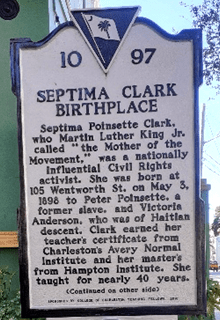
Septima Poinsette Clark grew up as a young girl in my neighborhood…a block over on Wentworth Street across from Grace Church. I have started and stopped writing this article on her ten times. I want to write about her because I admire what she made of her life as a black woman in Civil Rights Charleston and the national movement…even being called the “Mother of Movement” in the 1960s. But also, because she was the daughter of a plantation slave here who tried to trace her father and honor his experience.
But, I am just an old white woman who had no experience of slavery…or really, even the Civil Rights Movement which I saw on TV. That makes me unqualified to add my two cents to her story. And yet I wanted to do something for my blog on her that I could also feel good about…so I began to look at the large number of articles and books already done on her to see what I could add.
Narrowing the field…
I began, of course, by searching for books on Septima or articles on the internet, and there are many. She is a national heroine as well as a Charlestonian. But as I read, I found myself concentrating…as she did…on the story of her father, Peter Porcher Poinsett, and his early memories of being a slave. All she had were a few memories of a few events in his life…as he remembered them…and his name. She did not have a birthdate. He had vague recollections of his parents though he didn’t think they were on the same plantation as him and he did not really have their names. He mentioned a Grandmother Shien, as perhaps the first slave ancestor but she couldn’t be traced…though Septima tried. She knew of his siblings, but they were scattered. Unfortunately, that is the norm for tracing slave’s lives.
Septima tried heroically to tie her father into each new Charleston theory on how slaves got to the extensive slave marts here…but the most valuable clue she had was her father’s name…and the custom of naming slaves after their masters. An unfortunate fact of searching for a family’s slave ancestor is that sometimes the only road that leads to them is their slave master’s name. For Septima’s father to be named Peter Porcher Poinsett, meant that he had been born on a Poinsett plantation.
Fortunately…or not…plantation owners were the often well documented. They were the movers and shakers of the fight for American Independence. Many served in the new government. They raised the money that fueled their political ambitions from their plantations. They were the early English/Scots/Huguenot settlers who sent their sons to Europe to be educated and in turn to serve in the government. They left a trail…and old Charles Town was one of their centers outside Washington, D.C.
Over the years, while helping people research their genealogy, while working in the archive of the St. Charles County Historical Society in St. Charles, MO, the research tool I used the most was chronology. It sounds trite to say it, but I had learned from experience that by putting all the dates available for the different people in the family or area in order, amazing things can be uncovered. “Where were they when” can clear up many family mysteries.
So that is what I could do for Septima…I could take her memories of what her father had been able to tell her and her siblings about his early life as a slave. The fact that his surname “Poinsett,” was given to him meant that he was born on “Poinsett’s plantation.” This was the crucial clue and Septima followed up on it. Poinsett was greatly revered in the area as “Statesman Poinsett.” Joel Roberts Poinsett was a well-known historical early Charleston personality. Finding him led to the other name that was important…either because her father knew it or because Septima found it when researching Poinsett; “Pringle.” She already discovered that the Pringle family inherited Septima’s father along with the plantation when Poinsett died.
This is the area I will focus on, also. Let’s see what adding the master’s dates and a bit of their story will add to the memories of Septima’s father, Peter Porcher Poinsett.…and since it is now February 2026…Black History Month in yet another fraught time…I needed to quit dithering and get on with it.
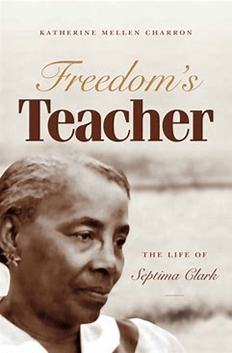
(I will include book covers and link some sites that give details of her full extraordinary life and career in the Civil Rights Movement of the 1960s for those new to her story.)
A few warnings…dates do not always match up…one of the perils of genealogy. That rule is very evident with Septima’s father….as we will see. The best we can do is get as many sources as possible of verification and then run with it…but like running with a sharp stick, keep your eyes out for hazards. Another Peril of Genealogy is that as soon as you commit to a date in writing, something will pop up to tell you that you are wrong…you are always writing a “work in progress.”
I am considering this exercise an historical fiction…because it is me looking at the scant information available and comparing dates and asking what if…but I have been doing this a while and take “coincidences” seriously, because the genealogical rule of always having three sources wasn’t always possible.
To Begin
When I began my search for Septima’s father’s history, there was only one book that the Charleston County Library would let me check out. The library prefers you to come into their research room to read historical books…not an option for me. Serendipitously, the one I got delivered by Bookmobile to Canterbury House was a new book. It was not a scholarly tome, but it had what I needed to work with for the laser focus I was doing…The author, Carolyn Jenkins, delves into Septima’s background and life quoting other author’s books written about her and from the one’s Septima wrote herself that recorded her words…sort of a revue…perfect…
So, with all those caveats, Let’s begin and see where we go.
Septima’s Father’s memories…and what she found when she searched…
As quoted from BLAZING TOWARD FREEDOM Septima Poinsette Clark’s Story From Slave to Queen Mother of the Movement by Carolyn Pearson Jenkins 2024.
First Memory: Peter’s Memory of his owners…
(Page 27 What Septima thought from a quote dated 1999)…Around 1846, American Statesman Joel Roberts Poinsett…enslaved Grandmother at White House (plantation), a schoolhouse was through the entry gates…As is common for one family to own several plantations, the Pringles, Father’s owners after the death of John Roberts Poinsett, were no exception. The Pringles owned Beneventum and Greenfield plantations on Black River and Arundel Plantation on the Pee Dee River. However, it was White House plantation that connected the Pringles to my family, with Father having been born and living there during his life as a slave….Indeed, it was recorded if you look hard enough.(!?) It was in the Monks Corner/Greenfield area of South Carolina…just over the Cooper River and south of Mt. Pleasant.
Second Memory: Peter remembered having to walk the master’s boys to school every day carrying their books while they rode horses. He was not allowed to enter the school.
(Page 31) …Even though Father walked to school everyday (one thought to be on the property) carrying the Pringle boys books, (while they road horseback) he couldn’t enter the classroom to learn. He stayed outside all day, rain or shine, and attended the (boy’s) horses. At the end of the school day, Father walked back home carrying his masters’ schoolbooks while they again traveled on horseback. As the Pringle boys became literate, Father remained illiterate. Even though Statesman Poinsett died in 1851, when Father was four or five years old, Father said he remembered his owner. I don’t know if Father was referring to Statesman Poinsett or to JJI Pringle who inherited Father from Poinsett. In later years, Father expressed no ill will to us towards his master or slavery. After all, as a house slave, “house native” as he called himself, White House was the only world and the only culture he had known from birth to 1861.
Third Memory: Thoughts on Poinsett and Following the Pringle boys into the Civil War
JACQUELYN HALL: And Joel Poinsett was the inventor of the poinsettia, and he was a Unionist. (Me…Unionist: One who didn’t want the South to succeed from the Union. He spent his career working for the Union.)
SEPTIMA POINSETTE CLARK:Yes, and gave the poinsettia his name.
JACQUELYN HALL:How did he fare in the South just before and during the Civil War, as a Unionist? Did you ever hear any stories about that?
SEPTIMA POINSETTE CLARK:Yes, I read some, and it hasn’t been too long, when this guy Sam Slate, who’s writing a book on Joel Poinsett, came in—that was just a month ago—from Connecticut, and he sent me a book called Satan’s Corner, and it talks about Joel Poinsett…But they [UNCLEAR] that, although there were slaves on his plantation, that he was a very non-violent man and had wonderful ways of working with the slaves…
“And then when the Civil War came, he took water to the soldiers who were fighting to keep him a slave, to fight against the people in the harbor who were coming to free him. He really felt that it was perfectly all right. And carrying wood to stoke the cannons to shoot the balls at those ships…He was serving the boys in the war…”
“Her father, Peter Poinsette, was forced to serve as a messenger to Confederate troops as a young slave during the Civil War. Her father, Peter Porcher Poinsette, was born into slavery on the Poinsett Plantation near Georgetown, South Carolina. In bondage, he was forced to serve his owner’s sons as they fought for the Confederacy.”
Peter Poinsette: Yeah, he was eleven, say eleven, years old (3) at that time and he evidently was traded or sold to a Colonel Gabriel Manigault. He acted as a messenger, and sort of a valet for Colonel Gabriel Manigault and he often made trips between here and a place called Pocatallego, bringing messages back and forth for the family.
Interviewer: I see. Now the Colonel was in Charleston, living in Charleston? …
Peter Poinsette: Yeah, yeah, yes.
Interviewer 2: Rice planter?
Peter Poinsette: He was the… there was two brothers, Peter and Gabriel, and they have the Manigault house on Meeting Street right on the south of the auditorium. Not the auditorium, the museum.
And he commanded some of the Confederate forces heavily by Pocatallego, and he was wounded down there. Now after he was wounded, I don’t remember just what happened to my father because, as I understand, he was evidently traded to a mayor Macbeth1, who was the mayor of Charleston at that time, and I understand that when the city surrendered, he drove the mayor MacBeth from somewhere on this same Cannon Street down to City Hall to surrender. And after the war, he was evidently trained in the house as a porter – not a porter… Interviewer: A butler? Peter Poinsette: A butler. That’s the profession that he followed most of his life
Okay…those are the family’s source materials…Let’s see what adding the owner’s dates and chronologically to the mix will show us…
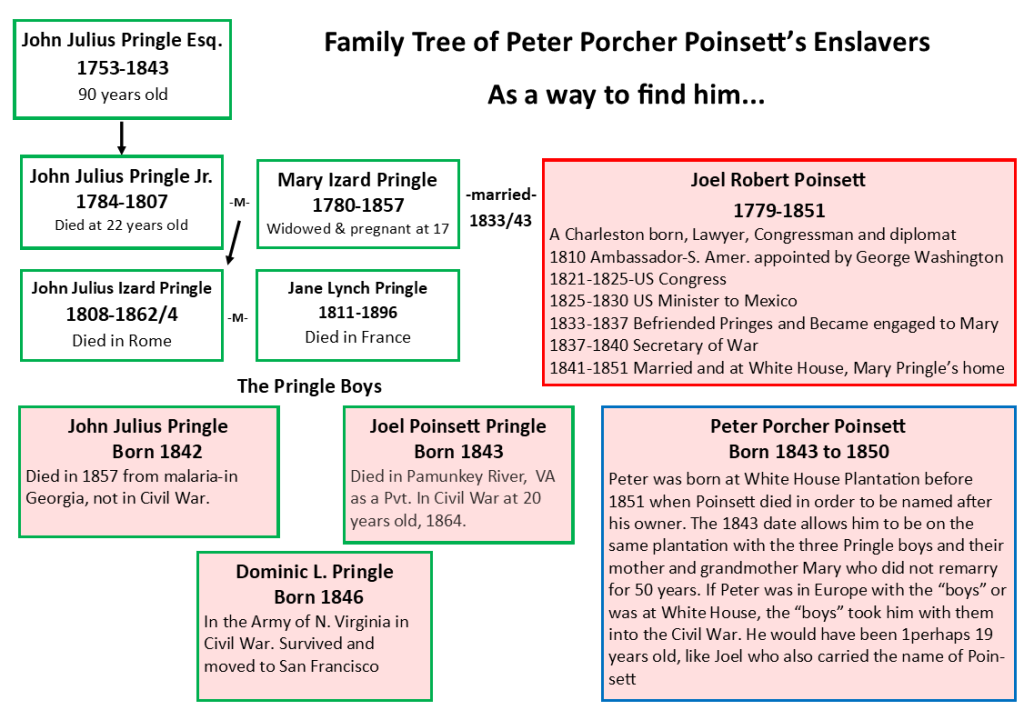
The illustration/chart is my using Septima’s information and information I found on the slave owners as is available in online sources …mostly Find A Grave.
Putting it all together…
(1) Birthdate for Peter Porcher Poinsett: Sources list a wide range of dates for Peter Poinsett’s birth…more later. Early on, most settled on 1849 because it was agreed that 1851 was the latest date possible for Peter to be surnamed Poinsett because that is when Poinsett died. And an 1849 birthdate allowed Peter to have a memory of Statesman Poinsett, though he would have only been 3-4 years old as Septima said above. After researching the Pringle and Poinsett dates, I now think it possible that Peter was born in or around 1843 rather than 1849. One reason, 1843 as the Peter’s birthyear meant he would have been 8 years old when Poinsett died and more likely to have memories of him.
(2) Statesman Poinsett: The second reason for choosing 1843 as Peter’s birthyear has to do with Mary Izard Pringle. She is on the chart. She was the Pringle widow who married Poinsett in the generally used year of 1833 that got him to White House in time to give Peter his last name. But here, dates get wonky again. If she remarried in 1833 that was 36 years after she was widowed when she was 53. That is the age it is agreed she was when she married Poinsett…he was also in his mid-50s.
This is complicated but worth a look…
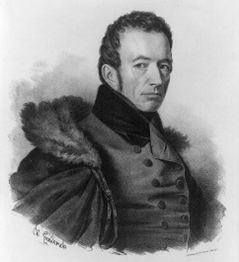
I saw right away that Joel Roberts Poinsett was a very busy man. Wikipedia allots 5 or 6 pages to his accomplishments. Joel Roberts Poinsett – Wikipedia…Most of it good…he knew Napolean…he was a world traveler, he worked with George Washington in the establishment of the nation, he was involved in the Monroe Doctrine…but he also did some awful things…the whole American Manifest Destiny belief to own the continent and to displace those who were already here….Here is the most awful thing…
Poinsett served as Secretary of War from March 7, 1837, to March 5, 1841, overseeing the forced ethnic cleansing and dispossession of land from Native Americans to European settlers known as the Trail of Tears…reduced the fragmentation of the army by concentrating elements at central locations…and again retired to his plantation at Georgetown, South Carolina, in 1841.
Leaving office in March 1841, Poinsett spent his last decade on his Greenville District farm and his wife’s Santee plantation near Georgetown. In retirement, he promoted education, economic development, and weaning of southern life from slavery. In 1844 Poinsett was elected president of the National Institute, a forerunner of the Smithsonian Institution. He served on the board of visitors of South Carolina College.
On Oct. 24, 1833, at 54 years old, Poinsett married a 52-year-old, wealthy widow from South Carolina who owned a rice plantation and almost 100 enslaved people.
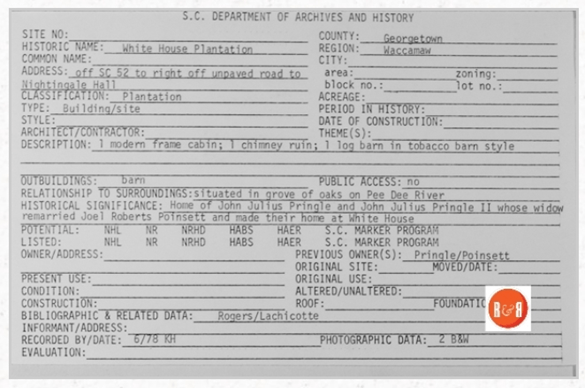
Oddly, there is an inventory of two Pringle plantations dated from the year 1843…and Mary was a Pringle! Maybe the inventory was done to settle the estate of the elder Pringle who died that year. There were two plantations listed but this one was the closest to White House.
157 Enslaved Ancestors Listed at John J Pringle’s Pee Dee Plantation, 1843 (Slave names are listed…including two Peter’s with no Peter’s listed at the other plantation…see below.)
(3) Mary Izard Pringle…Septima’s father’ owner.
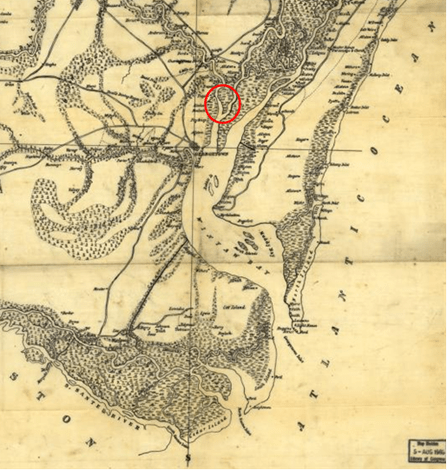
1823 Map…hard to read but inside my red circle are the names Pringle AND Izard.
So… a slightly different version of Mary Izard Pringle’s role. She owned the plantation and she had “almost 100 enslaved people.” It is true, as shown in the illustration/chart, that Mary was 17 years old when she married the eldest Pringle son in 1807. Both her father, Ralph Izard, and the elder Pringle had land next to each other and even worked together…see below. It was a typical marriage between plantation families. The1823 map shown here that I put a red ring on is to show what is very hard to read…It shows Pringle and Izard one barely above the other in the vicinity of White House Plantation. Here are brief biographies of Izard and the elder Pringle…
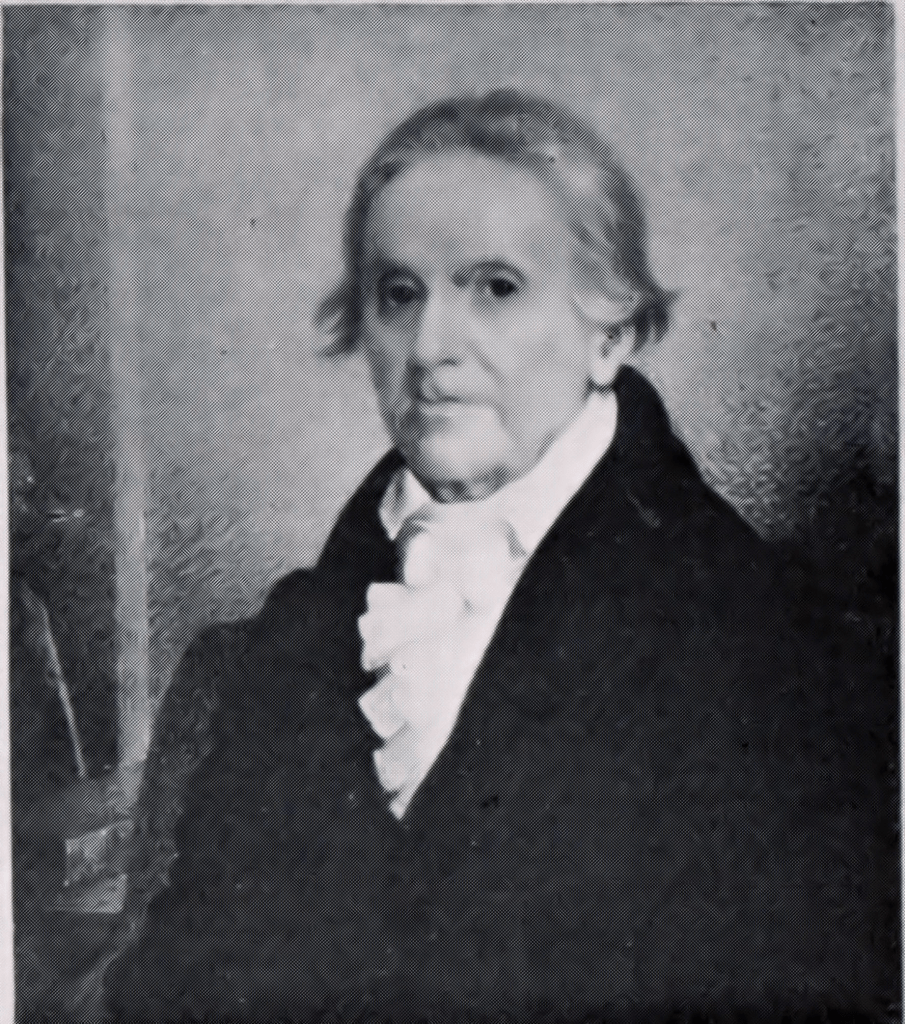
(4) Ralph Izard, Mary’s father
“Ralph Izard, junior…member of the Provincial Congress, the Assembly and
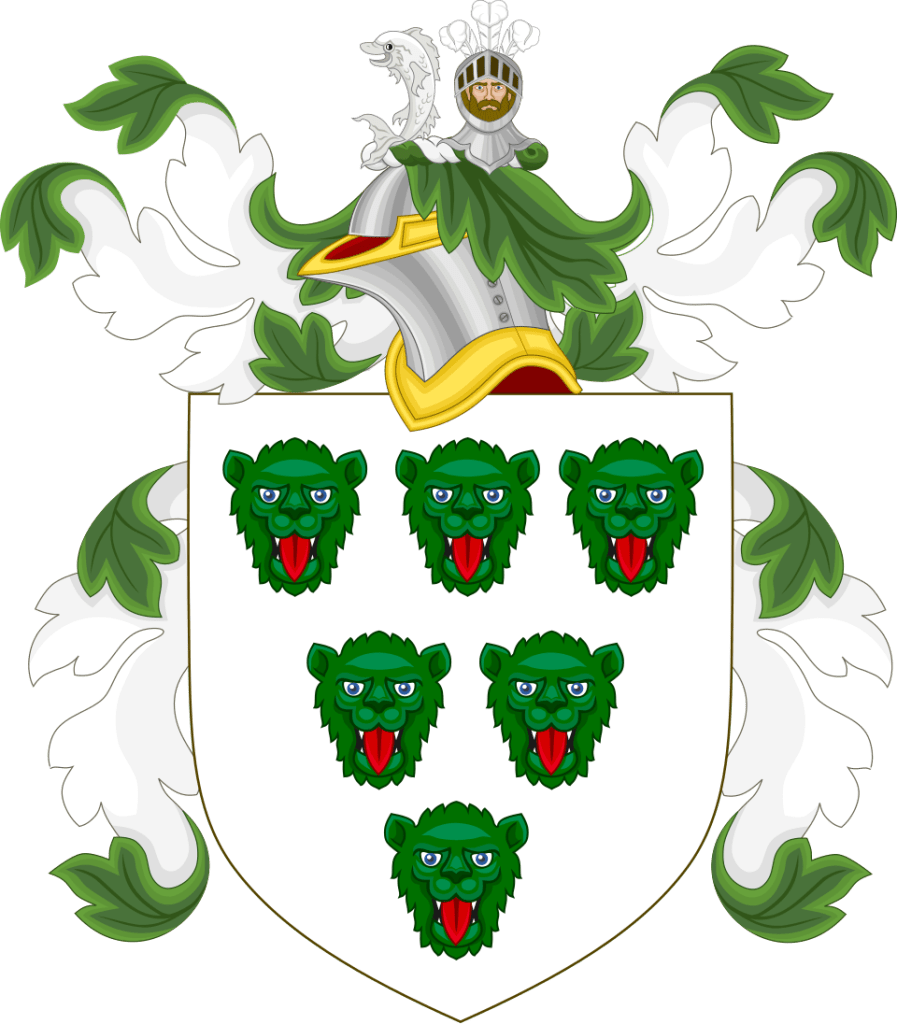
Coat of Arms of Ralph Izard.svg
Constitutional Convention, was born in 175-, in Carolina and educated there and in England…returning to Carolina, he supported the American cause, was in the Commission of the Peace for Berkley -County and, 8 Nov. 1775, was elected to the Provincial Congress for St. John’s’ Colleton…and later 1788 in the House of Representatives and the Convention on adoption of the Federal Constitution. Mr. Izard resided at Fair Spring until 1790…and his Town house in Broad Street…and possessed a very large estate which he increased by the purchase of valuable rice plantations, Weymouth, Hickory Hill, Milton, White House, .&c., on Peedee River….
John Julius Pringle Sr. (1753-1843) – PRINGLE, John Julius, lawyer, born in Charleston, South Carolina, 22 July, 1753; died there, 17 March, 1843. His father, Robert (1702-’76), came from Scotland to South Carolina about 1730, became a merchant in Charleston, and in 1760-‘9 was a justice of the court of common pleas. The son… read law with John Rutledge and in England, where his published articles in defense of colonial rights attracted attention. At the beginning, of the American Revolution he went to France, and in 1778 he became secretary to Ralph Izard, United States commissioner in Tuscany… In 1787-‘9 he was speaker of the state assembly, and in the latter year he served for a short time as United States district attorney, by special request of General Washington… and from 1792 till 1808…but family reasons induced him to decline. Mr. Pringle was for four years president of the trustees of the College of Charleston.
Both men worked together in Tuscany and got plantations near each other in the new nation. Pringle retired in 1808 for “family reasons” just after his son died and his grandson was born…and the year that Mary began her long, long widowhood. According to now arcane Dowery rules and widow’s dower, she may have been left destitute…any dower she had brought to the union being held by the elder Pringle…though she would have been allowed to live on the property. But, and perhaps because of that, the courts will award Mary the White House Plantation when her father died in 1813. Here is a list of who owned White House when…
Circa 1794 – Ralph Izard bought the plantation from Samuel Smith (2, p. 251).
Circa 1813 – Ralph Izard died without a will. The courts awarded White House plantation to his daughter Mary Izard Pringle (2, p. 251).
1857 – Mary passed away and left White House Plantation to her son John Julius Izard Pringle (2, p. 254).
Mid-1860s – John Julius Izard Pringle died while in Europe. His wife Jane Lynch Pringle inherited White House (2, p. 254).
Mary Izard Pringle…and stayed a widow until either 1833 or 1843…either 36 or 46 years later…a long time…one wonders why.
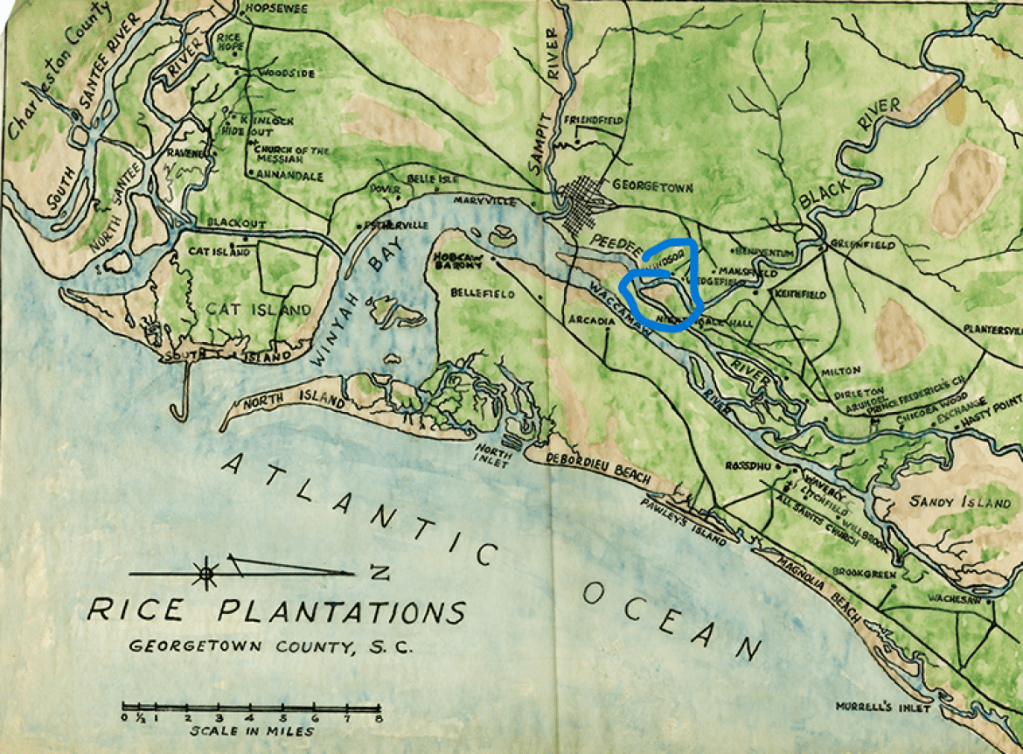
Rice-Map-1170 x 862 schistory.org with White House area circled in blue CMF
Here’s what I think: 1843 was the year that Mary’s Pringle patriarch father-in-law died. I think he may have tied her up in the courts or held something over her…her last name was now Pringle, after all…I bet there was some sort of provision that the White House Plantation would stay with Mary as long as she did not remarry!!!! Making it basically a Pringle Plantation. Something happened that kept her from remarrying all those years…and then remarrying just after Old Man Pringle died. And/or maybe it was when her son John Izard Pringle began his own family. He married Jane Lynch of New York, no date recorded, and their first son was born in 1842, having waited until he was 35 and his wife Jane was 30 years old.
This document says the land belonged to the Pringle men…though as we saw, it belonged on another list to Mary Izard Pringle…which legally can mean the same thing.
But Mary and her son commemorated her marriage to Statesman Poinsett. Her son named his second son born in 1843 after Poinsett; “Joel Roberts Poinsett Pringle” and a new slave born on their property or one purchased for the occasion was also named after her union with Poinsett; Peter Porcher Poinsett.
(4) The Pringle Boys
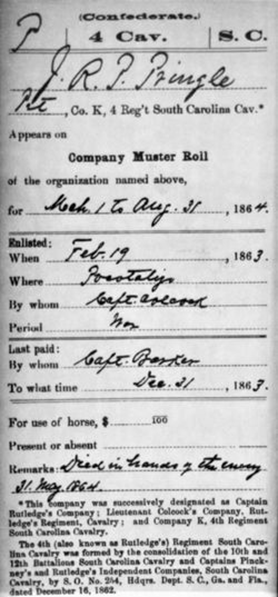
I think that there may have been a bond between the two “Poinsett” boys…one slave and one heir. Peter seems to have been assigned to the three boys…following them to school each day and back…perhaps from or to the next Pringle plantation where the school was for there to be a need for horses. That bond continued into the Civil War. There is an interesting manuscript from Jane Lynch Pringle’s family papers…the boys’ mother…about what the Civil War did to the boys…and left unsaid, how it affected Peter Porcher Poinsett.
Source: College of Charleston, S.C. Historical Society manuscript, Jane Lynch Pringle family papers
John Julius Izard Pringle married Jane Lynch of New York, and lived at his plantation “Greenfield,” six miles up the Black River from “White House”, where his mother lived with her second husband, Joel Roberts Poinsett… Life at “White House,” or “Casa Bianca” as it was called by Mr. Poinsett, is described by Frederica Bremer in ‘The Homes of the Nero World’, 1, 255-305: “A fine old couple, Mr. Poinsett and his lady, who remind me of Philemon and Baucis, live here quite alone in the midst of negro slaves, rice plantations, and wild, sandy forest land.” Miss Bremer, who was most interested in the lot of slaves, finds much to comment on in this connection, little unfavorable to her host. The snipe bog was famous at “White House,’ and J.J. Izard Pringle is said to have been a famous shot.” In April 1861, ‘White Hall,” by then the home of J. J. Izard Pringle, was visited by a British newspaper correspondent, William Howard Russell, who reported that Mrs. Pringle and the children were in Europe and Mr. Pringle anxious to join them.” He did get to Europe but died in Rome March 10, 1862. His three sons, who were studying in Heidelburg at the time of their father’s death, immediately hurried back to South Carolina to enter the army. Landing in the North, by July 1862 they were at home after many adventures getting through the lines. They “walked, waded, rowed in boats, if boats they could find; swam rivers when boats there were none; brave lads are they.” Mrs. Pringle and her daughter soon followed, they too being spirited over the lines. Jane Lynch Pringle died Augnst 9, 1896, at Dinard, France, in her eighty-sixth year.
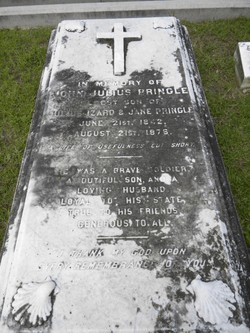
John, the eldest son will die as a “brave soldier” after the war in 1876…the date on his tombstone…not the date from the site I used for the Illustration/Chart.
A close bond between Peter and the young “Poinsett” also might address Septima’s concern about her father not being angry about being a slave…and refusal to say it was unbearable. He grew up with those boys. He was a house slave, not a field slave and called himself a “house native” not a slave. And he was probably thought special for being named after the new bridegroom Statesman Poinsett.
JACQUELYN HALL: “Did your father say that?” (about Poinsett)
SEPTIMA POINSETTE CLARK: “Well, my father never found any fault with him whatsoever. In fact, he didn’t find any fault with any white people at that time; he was just that way. The reading and writing that he didn’t get didn’t bother him. He just talked about taking these kids to school and not ever being able to go in and learn to write his name. But he didn’t feel worried about that, either. And he sat outside all day long with the horse until they came out of school, but not once did he go in their classroom. But it didn’t bother him.”
But it bothered Septima for him…
There are two last things I want to address. The first is the much-disputed date of Septima’s father’s age.
Peter Porcher Poinsett’s Age
Brief Life History of Peter Porcher Poinsette… Family Search
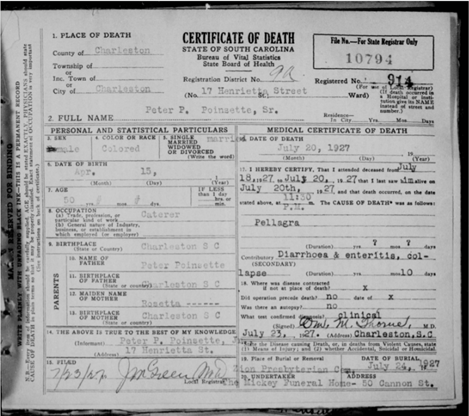
Peter Porcher Poinsette was born from 1845 to 1871, in Charleston, South Carolina, United States as the son of Peter Poinsette and Rosetta. He had at least 4 sons and 5 daughters with Victoria Warren Anderson. He lived in Saint Johns, Berkeley, South Carolina, United States in 1880. He died on 20 July 1927, in Charleston, Charleston, South Carolina, United States, and was buried in Charleston, Charleston, South Carolina, United States.
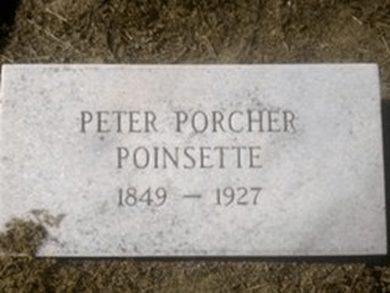
Wiki Research…An Atlanta Constitution article about his daughter, Septima Poinsett Clark, states: “Mrs Clark’s father was born a slave, her grandmother having been pregnant when she arrived from Africa in 1846 and was bought by rice plantation owner Joel Poinsett…..” (p. 4-B). Therefore, Peter Poinsett was born in 1846 or 1847, close enough to the 1849 reported on his tombstone.
His death certificate does not list a date of birth. If he was born in 1849 as on his tombstone, he died at the age of 78…not 50 as listed. If he was 50 when he died, he would have been born in 1877, and all his memories would not have applied to him but perhaps his father. Also on his death certificate, Peter’s father is listed as Peter Poinsett…making al; the memories about Septima’s grandfather. A true mystery.
The inventory of slaves given above taken in 1843 did show two “Peter’s”. But no surnames were given. The most logical scenario would be that the death certificate said “Poinsett” for Peter’s father when they mean “Porcher.” A simple error. Peter Porcher was Septima’s grandfather and her father was Peter Porcher Poinsett having been born during Statesman Poinsett’s few years at White House. Perhaps someone else has or will take this a step further….
Ancestors listed at Pringle’s Pee Dee Plantation were (above):
Also, his mother on the death certificate is listed as “Rosetta.” There was no Rosetta named on either plantation list though there was one Rosetta in the area. Mary Izard had a sister named Rosetta and she died in 1812…so…there could well have been slaves named after her. Another mystery. Septima said that she knew of her grandmother but never knew her.
Where did the name “Peter Porcher” come from?
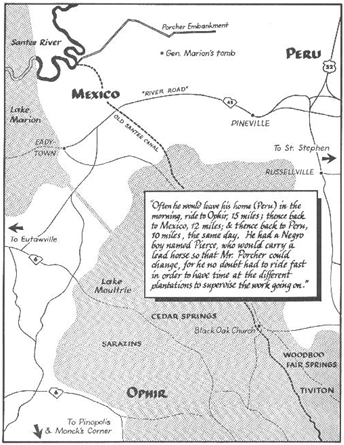
But among the Pringle, Izard, Poinsett family names, there are no Peter’s. But there is a very prominent family of plantation owners in the general area named Porcher and Peter was a family name. In fact, a man named Peter Porcher was legendary….A certain Peter Porcher, a Huguenot and nearly an original settler, acquired a large amount of land along the Santee River. He eventually had four huge plantations which he named for newly explored Mexico and South America; Mexico, Peru, and Ophir, named for the gold found there.
I found a detailed article that describes the plantations, but it was mostly in awe of Peter Porcher or “Peter of Peru” as he was known locally.
Mexico, Peru, and Ophir
by Mr. F. M. Kirk
The Porchers were remarkable for their ability to accumulate lands and to make fortunes from those holdings. Among the many plantations in Berkeley owned by members of the family were Mexico, Peru, Ophir, Sarazins, Cedar Spring and Walworth. The families, as were others of that time, were known by their plantations. There were, for example, the “Ophir Porchers,” the “Walworth Porchers,” etc. In addition to their plantations the Huguenot descendants had extensive holdings in other counties and in the City of Charleston. Only one male Porcher lives in Berkeley County today where an old slave is said to have declared them “a mighty nation.” The sole survivor, in Berkeley, of the emigrant Dr. Isaac Porcher, who came to Carolina about the time of the Revocation of Nantes, is the son of Percival Ravenel Porcher who with his brother, Isaac de Cherigny Porcher, was the last of the pure-bred Huguenots. So successful were the agricultural pursuits on lands settled by the Porchers and so extensive their fortunes that Mexico, Peru, and Ophir were named for those places that signified great wealth. Each plantation lived up to its name. Peter Porcher, more popularly known as “Peter Porcher of Peru,” grandson of the emigrant, was born July 8, 1726, owned and named the three plantations and resided at Peru. His sons settled the other places.
A final word
To bear the name of Peter Porcher might have had a certain mystic…it was probably Septima’s grandfather’s name with “Poinsett” added to his son’s name. and adding Statesman Poinsett to the name and being a house “native” bonded with an owner’s son rather than a field slave, might have not been as bad as most had it…and hence Septima’s frustration…in the midst of the Civil Rights Movement in deepest red Charleston. She did, however, pick up his biggest problem and run with it. He expressed his disappointment with not being able to learn to read…that is what she dedicated her life to…her mission became to teach the African Americans of her day to read so they could VOTE.
I haven’t gone into her later life. She has been honored with a highway named for her and an historical plaque outside her early home. I want to close with Septima’s closing words as she retired from teaching and the Movement and entered a nursing home…from Closing from Blazing Toward Freedom page 173-174
So that’s the long story of who I am. Yet simply. I am the daughter of a former slave…. I am a life-long educator. I helped develop a curriculum that taught adults leadership skills and how to pass Jim Crow literacy tests to obtain voter registration rights. The curriculum expanded throughout 11 southern states and wove in and out of the fabric of the Civil Rights Movement. As a result of the trainings, over 1,000,000 Blacks were registered to vote (Jenkins 2023) and helped change the political landscape of the American South during the 1960s.
 Finding "My" Charleston...Digging down on the block I live on...to see what I can find.