Reverend Dana continues in the News and Courier Charleston SC July 14, 1873, article…
The career of the church had been singularly peaceful. No schism had existed. The half-century under review may be divided into four parts. The first of twelve and a half years; the second twelve and a half years, ending July 1848; and the third of twelve and a half years, ending January 1861 (of greatest prosperity)
The first movement was set on foot towards a new house of worship…In July 1847 (beginning the 3rd phase of twelve and a half years) my health required me to be absent from duty for a time…and a suggestion was made to have some repairs done to the church… (after much discussion it was determined to build a new temple) …

Oddly, the first Charleston old town map I found with Third Presbyterian Church on Archdale Street on it, was the one for 1849 when the church was planning to build their new temple.
You can see in the red circle I drew around the dot showing the church on Archdale Street, just to the right of the word “West.” In words barely readable with a magnifying glass to the right of the dot in italics are the words “3rd Presby.”
In the previous posts on the church cemetery, I have included maps showing the graveyard and drawings indicating buildings…but no names on them because by then Third Presbyterian had moved and perhaps the buildings were empty…at least no longer a church…except for the unnamed “graveyard.” (I also included this map in the last post to show where the fire well was…at the top of the circle in the middle of the intersection of Archdale and Beaufain.)
From the Charleston News and Courier 1953 Article I have quoted many times in the previous posts on the church under my parking lot:
“Mr. Halsey (an alderman who discovered the grave yard under a garbage dump) has been at some pains to piece together the history of the cemetery and former churchyard…ending with: “The church on Archdale …was demolished some time between 1850 and 1860. A few burials were made subsequently, but by 1870 all records indicate the site had been abandoned.”

However, the 1884 Sanborn Fire Map (on right) still shows the church buildings…in the same spot on the 1849 map, though it was not a church anymore according to the accounts I have been quoting. According to Sanborn’s code, the yellow buildings mean that they were wood frame. Pink buildings are brick.
But why would they decide to move to a new location? Reverend Dana does not say. (Looking at the histories of other nearby churches, many mention that a lot of their early records have been lost, so most histories now repeat the founding stories and skip to later times…with no reason given for the loss. But there were all those fires, of course, that Reverend Dana and the other church websites do not mention.)
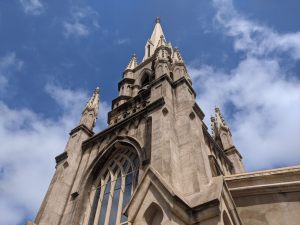
1850 as Third Presbyterian moved into their new church on Meeting Street,
Other than crediting the “ladies” for getting the ball rolling for his congregation to move, in Phase Two in the last post, we get no clue as to why they moved. So, I hazarded a guess. They had only been at 37 Archdale Street since 1823…25 years, though the wood frame building was erected in 1814. I’m thinking that though the decade of fire hadn’t actually reached them, the handwriting was on the wall for the old frame building. And to be safe, new churches were being built of brick and stone.
Third Presbyterian moves downtown and becomes Central Presbyterian
On February 3, 1850, this beautiful piece of architecture was dedicated…Then the Central Presbyterian Church began a new and brilliant career.
Reverend Dana continuing in the 1873 newspaper article.
Things are murky…but they often are…For now, we will celebrate the new “temple.”
First…where did they move? They moved into the Burnt District…273 Meeting Street…closer to the social, religious, and governmental centers in the heart of Charleston and perhaps hence the new name “Central.” But still…they moved into the infamous Burnt District of 1835 and 1838…
When I was showing the Burnt District (white area) map and citing what happened during the 1838 fire in the last post, I said “Remember this paragraph.” I think it explains how a small church on the outskirts of town got to be a big church.
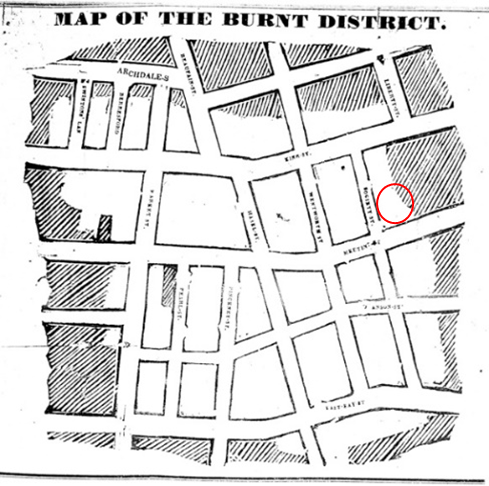
“Following the fire, City Council passed a series of ordinances limiting wood construction…On June 1, 1838, the South Carolina General Assembly ratified An Act for Rebuilding the City of Charleston “to rebuild that portion of the city of Charleston now lying in ruins.” A fund backed by state-issued bonds provided construction loans on the “condition, that the money loaned shall … be expended in the erection of brick or stone buildings.”
Charleston Daily Courier, Mercury, and Southern Patriot, various dates. PUT IN LINK FOR NAP
central presbyterian…still with Reverend Dana as pastor
And this is what they did with the corner of Society and Meeting Streets. (The name of the church on the link below, “Westminster”, is the Third/Central congregation who will go through yet another name change…more later.)
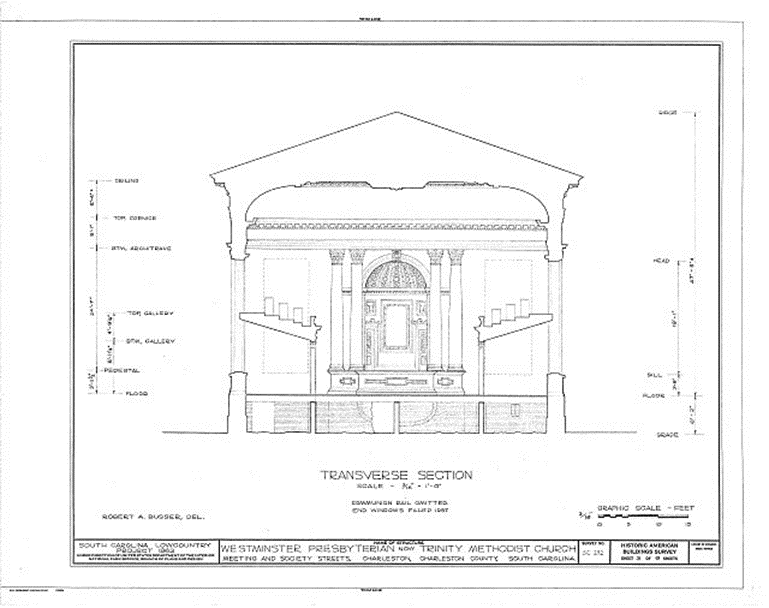
Historic American Buildings Survey National Park Service Eastern Office, Design and Construction 143 South Third Street Philadelphia, Pennsylvania
PART I. HISTORICAL INFORMATION A. Physical History 1. Original and subsequent owners: Westminster Presbyterian Church Congregation. Purchased in 1926 by Trinity Methodist Church Congregation [inscriptions, carved on stone, set into the portico]. 2. Date of erection: 1848-50. 3. Architect: Edward C. Jones. [Ravenel, Architects of Charleston). 4. Notes on original plans and construction: The following is from Ravenel, Architects of Charleston. Quotation from the Courier of August 26, 1848: “We were much gratified yesterday, by an examination of the working plans for the Presbyterian Church, proposed to be erected for the Rev, W. G. Dana’s Congregation. ..*.. It will be in ‘Temple’ form, with portico of six Corinthian columns, fronting on Meeting street, and one on each return to the Ante. The ascent to the portico will be by eleven steps—five to the first platform, and six to the ‘Portico’ proper. The exterior dimensions will be ninety-six feet in length, fifty-four feet in width, and fifty-six feet, (including basement) in height. … “The plans and drawings are by a very promising young artist, Edward C. Jones, a native of our city. They indicate decided talent, and if faithfully carried out in the completion of the building must establish at once the reputation of (Third Presbyterian Church)…
Property File – 275 Meeting Street (Trinity Methodist Church) | Historic Charleston Foundation (pastperfectonline.com) (The name on this site represents again a change…more later.)
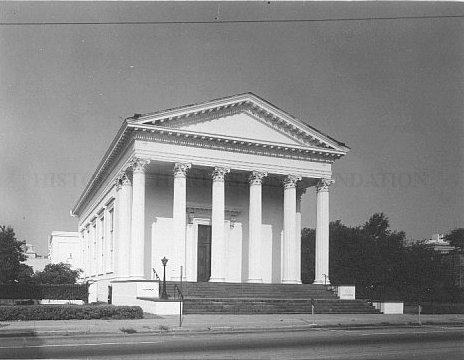
Archive Record–275 Meeting Street–Scope & Content
Constructed 1848-50. Edward C. Jones, architect. Perhaps the least altered of Charleston’s late-Greek Revival church buildings, Trinity was actually constructed for the Third (later Westminster) Presbyterian Church. Often compared to the Church of the Madeleine in Paris and its predecessor the Mason Carré at Nimes, primarily due to its monumental Corinthian-columned portico and massive dual flight of stone steps, the building nonetheless reflects its region with its large winding and contemporary technology with its cast column capitals. Inside the church’s louvered shutters over the tall windows, open galleries, and central apse, decorated with molded plaster anthemions and other embellishments and flanked by four Corinthian columns, portends the end of the simplicity of the Greek and the emergence of the Roman Revival and the more elaborate styles of the late antebellum period…
File contains newspaper article about church’s restoration (1957); building history from Architectural Guide to Charleston (by Simons & Thomas).
Reverend Dana does not mention the process of building or moving in…but skips to 1856 to continue his church history in the 1873 News and Courier article…
In 1856 (the debt was paid off in total and church finances blossomed including a donation of a beautiful organ.) … In 1860 the income of the church was three thousand dollars. From 1856 to 1860 the yearly contribution to foreign and domestic bible society and etc & etc, averaged nine thousand dollars per annum. There was so little demand from indigent members that the sacramental collections were ample to the expenses…This church has always been characterized by peace and harmony, and a remarkable exemption from death during this period…
Third Presbyterian Church was right in step with the times…
Charleston SC Christmas in 1860 (charlestonlivingmag.com)
By SUZANNAH SMITH MILES
“In December 1860, Charleston shimmered with wealth and prosperity. The city was at the zenith of antebellum splendor. Here was the Victorian Era in all its exaggerated affectations, with ladies in lace-frilled hoopskirts and dandies in top hats carrying gold-knobbed walking sticks. Home interiors were dressed with heavy mahogany furniture. “Turkey” carpets covered the highly polished floors.
“From the great mansions along the Battery to stately single houses in Wraggsboro, front doors were bedecked in greenery for the holidays. Inside, the cedar tree was trimmed and its tallow candles ready for lighting on Christmas Eve.
King Street’s store windows brimmed with holiday cheer, with shops offering everything from Christmas confections and children’s toys to “bonnets, flowers and feathers.” Adding to the gaiety, the famous George Christy’s Minstrel Show was in town. During their Christmas afternoon show they promised to give out 600 presents to children.
“We pass our evenings very pleasantly with music and reading & sewing & talking,” wrote Meta Morris Grimball in her journal. She and her husband, John Berkley Grimball, lived on their plantation south of Charleston. Their Christmas tree was “fixed off in a very lively and interesting manner,” she wrote, and decorated with ships and dressed dolls and lighted by little tapers.
“It seems strange that we should be in the midst of a revolution,” she mused. All was “just the same & a great Empire tumbling to pieces about us.” She later added wistfully, “I do hope there will be no war, but a peaceful arrangement of our difficulties.” …
“King-street never presented a gayer and more lovely appearance than it did on the twenty-fourth of December,” reported the Charleston Courier. “It was alive with innocence and beauty. Sweet things and pretty things were purchased with a freedom and pleasure that showed clearly that the Yule-purse had not been affected by the state of change.”
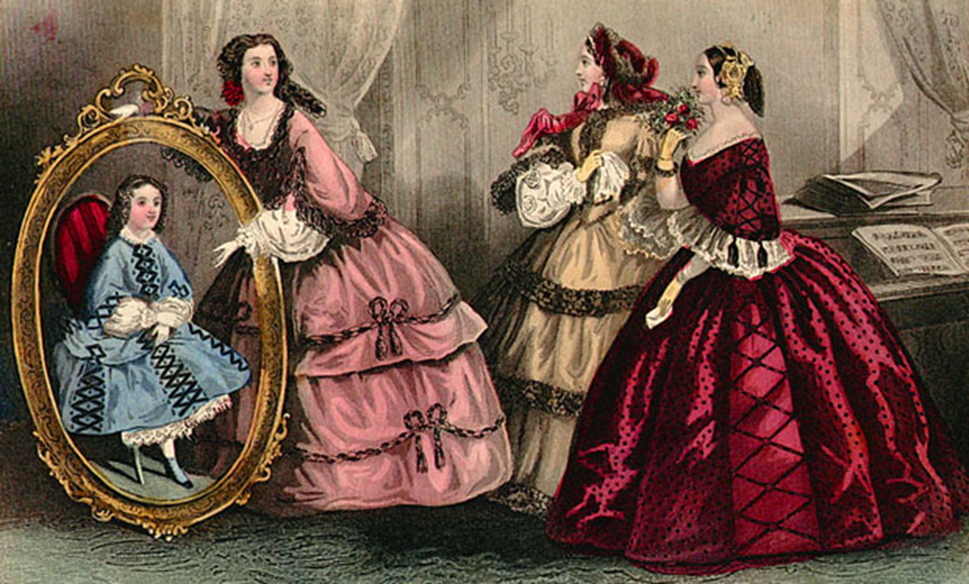
Reverend Dana said of this Phase “…ending January 1861 (of greatest prosperity)”, was, seen from hindsight, the calm before the storm. As Suzanna Smith Miles ended her article:
Meta Grimball had cause for worry. On December 20, South Carolina had seceded from the Union. Wrote planter and botanist Dr. William Henry Ravenel from his plantation in upper Berkeley County, “I now consider civil war inevitable.”
Reverend Dana will mention war in his last Phase…but not by name…
 Finding "My" Charleston...Digging down on the block I live on...to see what I can find.
One response to “Phase Three…1849-1861… of the Church under My Parking Lot…Prosperity”
[…] have all along worried that eventually I would have to address the Civil War. It came up in my first series on the church under my parking lot at Canterbury House and addressed the local abolitionists Grimke sisters and the Harvard and Princeton men who came […]
LikeLike